

About Next Generation NCLEX: RN® & PN® Exams
The NCLEX-RN® exam and NCLEX-PN® exams have been designed to evaluate the competency of nurses who want to practice in the United States and Canada. The NCLEX® (National Council Licensure Examination) is administered by the National Council of State Boards of Nursing (NCSBN) and is one of the criteria used by state boards of nursing to determine whether a candidate is qualified to receive a license to practice nursing. With this in mind, the NCSBN has developed an updated version of the NCLEX known as the Next Generation NCLEX (NGN®).
The NCLEX-RN is for registered nurses and the NCLEX-PN is for practical/vocational nurses. The main difference between the NCLEX-RN and NCLEX-PN is the level of nursing practice they measure. The NCLEX-RN is designed for graduates of registered nursing programs, while the NCLEX-PN is designed for graduates of practical or vocational nursing programs.
Who Takes the NCLEX?
Anyone who would like to practice nursing in the US and Canada must take the NCLEX after graduating from an accredited nursing program. Each jurisdiction's nursing regulatory body (NRB) determines its unique requirements for eligibility. Common requirements include:
- Graduating from an accredited nursing program
- Passing the NCLEX
Make sure to check with your local NRB for additional state-specific requirements. In the US, there are two versions of the NCLEX—NCLEX-RN and NCLEX-PN. The one you take depends on the level of nursing you wish to practice. Canadian nurses must take the NCLEX-RN.
| NCLEX-RN vs. NCLEX-PN | ||||
|---|---|---|---|---|
| Exam Type | License | Requirements | Test Fee | Test Site |
| NCLEX-RN | Registered Nurse | Diploma from RN licensure program or an Associate Degree of Nursing (ADN) or a Bachelor of Science in Nursing (BSN) |
$200 USD* $360 CAD** |
Pearson Vue Testing Center |
| NCLEX-PN | Licensed Practical Nurse or Licensed Vocational Nurse | Diploma or degree in practical nursing (LPN) or vocational nursing (LVN) | ||
When do you take the NCLEX?
Once your NRB determines your eligibility to test, Pearson VUE will issue an Authorization to Test (ATT) via email. Your ATT is extremely important and is required to schedule an appointment to take the NCLEX. An ATT is typically valid for 90 days, but this may vary by jurisdiction.
You can typically take the NCLEX about 45 days after your graduation date, but you should check with your state nursing regulatory body (NRB) for specifics. However, just because you can take the NCLEX during this period doesn't mean you should.
First, you'll want to ask yourself some questions.
- When do you plan to begin working as a nurse? — Taking time off between graduation and the start of your nursing career could give you extra time to study.
- How good is your memory? — Taking the exam while the material is still fresh may be your preferred route.
- Are you prepared? — Taking the extra few months to prepare for the NCLEX may make the difference in passing the exam on your first attempt.
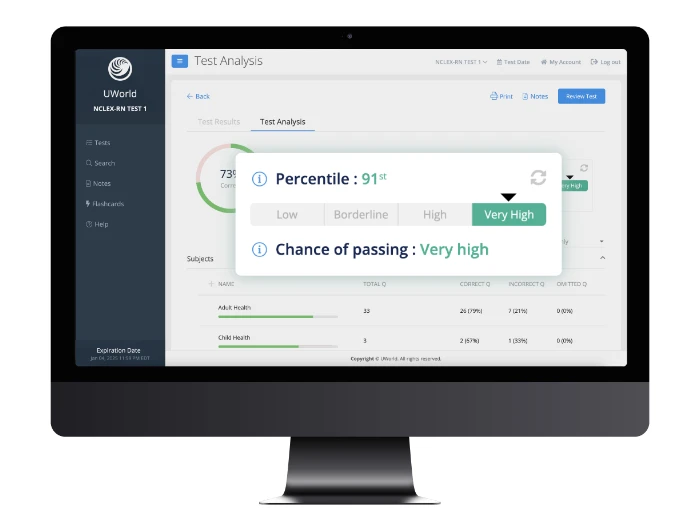
By first passing our Self-Assessment tests!
Next Generation NCLEX Format and Structure
The NCLEX is designed to test a candidate's knowledge and skills in various nursing competencies and is structured according to the eight Client Needs categories in the test plans. These categories provide a guide for ensuring that the exam covers a broad range of content areas and nursing competencies. In order to be successful on the NCLEX, you must become familiar with the content covered in each Client Needs category, the question types, and the exam’s time constraints.
Client Needs Categories
The content for the NCLEX-RN and the NCLEX-PN is distributed according to the eight Client Needs categories in the test plans. The Client Needs categories serve as a guide to ensure that the exam covers a broad range of content areas and nursing competencies. The Client Needs categories are the same for the NCLEX-RN and NCLEX-PN in six of the eight categories. They differ where indicated:
- Management of Care (Coordinated Care - PN)
- Safety and Infection Control
- Health promotion and maintenance
- Psychosocial integrity
- Basic Care and Comfort
- Pharmacological and Parenteral Therapies (Pharmacological Therapies - PN)
- Reduction of Risk Potential
- Physiologic Adaptation
For a comprehensive overview of content and its distribution on the NCLEX exams, visit our NCLEX-RN test plan or NCLEX-PN test plan.
What Types of Questions are on the NCLEX?
The NGN exam includes various new question types not seen on previous NCLEX exams, including case studies. The case studies are designed to assess your ability to apply nursing knowledge and critical thinking skills to complex, real-world scenarios. You will be presented with a patient case and a series of questions that relate to the case. The questions may require you to identify key clinical issues, prioritize nursing actions, and evaluate outcomes.
There are fifteen new question types, such as drag and drop, ordered response, and bow-tie questions. These new question types are designed to more accurately assess your knowledge and skills, and to better simulate real-world nursing scenarios. We have divided them into three categories to better explain how to interpret them.
The first column includes “choose N” types of questions. These are questions where you are told how many answer options to select. You are most likely familiar with “multiple choice” or “single best answer” questions.
The questions included in the second column require you to select as many options as are correct to answer the question. These types of questions are trying to see if you can select the relevant from the irrelevant information that is provided. The third column includes “cloze” type questions. You can think of these as “fill-in-the-blank” questions. You will be provided with a set of answer options from which to select one (or more) that complete the sentence. You may be asked to select the best response from a drop-down list of answer options, or from boxes with answer options that can be dragged and dropped into the blank in the sentence.
| Choose “N” | Relevant vs Irrelevant | Justification |
|---|---|---|
|
|
|
You can still expect to find the following ”traditional” NCLEX question types that will make up most of the exam.
- Single best response - select one correct answer option
- Multiple-response - select all correct answer options
- Fill-in-the-blank calculation questions
- Hot spot - identify one or more area(s) on a picture or graphic image
- Ordered response - drag the correct answer to the correct box in the correct order
- Exhibits - additional information provided to help answer traditional questions
- Audio/video - listen to an audio/video clip to gather information and then select the correct answer option
Practice. Practice. Practice.
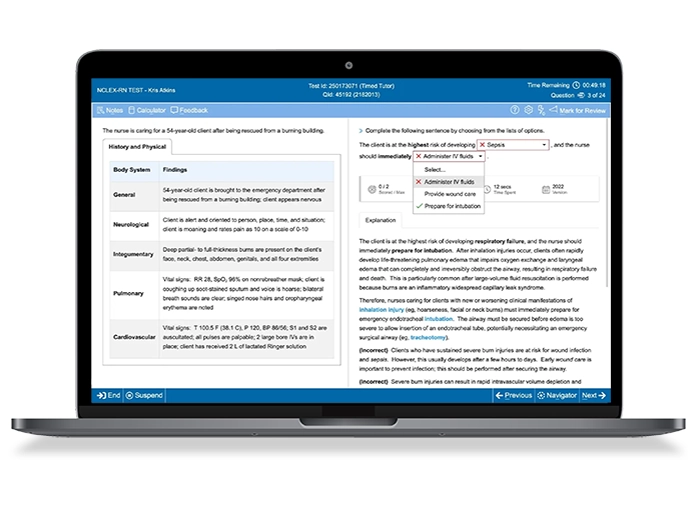
See what high-quality questions TRULY look like.
How long is the NCLEX?
You have up to five hours to complete the NCLEX and can expect to receive a minimum of 85 and a maximum of 150 questions. Of these, 15 are new questions that are being piloted or pretested for use on future exams and they will not be scored. The number of scored questions ranges from 70-135.
You can spend as much time as you want on each question within the 5-hour timeframe, but keep in mind that you have about two minutes for each question. Recent results from NCSBN’s beta testing show that students spent about one minute on each question. You’ll have the option to take a break after two hours of testing and another after three-and-a-half hours of testing. However, each break counts toward the five hour total time to test.
The computer will stop delivering new questions when the algorithm determines with 95% confidence that you have achieved competency. For example, the computer may determine that you've passed once you've answered the minimum number of questions (85) or, at any number after that, up to 150. If you run out of time or complete the maximum number of questions within the five hours, the computer will determine whether you are above or below the passing point.
Pre-test questions
You will receive 15 unscored questions, also referred to as items, as part of the exam, but will not know which questions are unscored. “There are 15 pretest items on every NCLEX-RN. Pretest items appear identical to operational items; therefore, it is recommended that you give your best effort to every item” (2023 RN Test Plan).
The pretest questions can include up to two additional, unscored case studies or as one or more NGN stand-alone clinical judgment questions during the minimum length exam (first 85 questions).
How is the Next Generation NCLEX Scored?
The Next Generation NCLEX (NGN) introduces a new scoring methodology called polytomous (partial credit) scoring. This means you can receive partial credit for correct responses on questions where there is more than one correct answer, rather than under the previous dichotomous (all right or all wrong) scoring method. The polytomous scoring method allows for a more accurate assessment of a candidate’s abilities, as it takes into account the level of proficiency demonstrated by each response. This means that even if you did not provide a completely correct answer, you may still receive partial credit for demonstrating some level of proficiency.
What is a CAT?
Computerized Adaptive Testing (CAT) delivers an exam that is customized for the specific ability level of the candidate, so each test is uniquely created for them. CAT uses an algorithm to dynamically readjust the difficulty of questions the candidate receives based on their response to the previous question. Initially you receive a question that is near the passing score. If the candidate answers correctly, the next question will be a little more difficult. If they answer incorrectly, they will receive a question that is a little easier. This continues until a stopping rule is triggered to end the exam with either a passing or failing score.
Passing scores are governed by the following three scenarios:
- Confidence Interval Rule — The computer ends the exam when it is 95% certain that an examinee’s ability is clearly above or below the passing standard. This is the most common scenario.
- Maximum-Length Exam — If an examinee's ability is close to the passing standard, the computer will administer the maximum number of questions and then determine a pass or fail.
- Run-Out-of-Time Rule (ROOT) — If time runs out and an examinee has not answered the minimum number of questions, they will fail. However, if they have answered the minimum number of questions, the computer will determine a pass or fail based on existing responses.
For more information about how each new question type is scored, visit our NCLEX Scoring Guide.
High-yield videos, thousands of practice questions, multiple self-assessment tests, and more.