Health Assessment Built for Nursing Educators
Replace static lab handouts with a dynamic digital course. UWorld connects hands-on physical exams directly to clinical judgment skills and NCLEX® success for LPN through BSN programs.
Health Assessment Requires More Than a Textbook
- Checkoffs completed without interpretation
- Fails to connect findings to care
- Cannot prioritize what to report
- Must build observational reasoning
- Videos and lab guides live in silos
- Curating content drains faculty time
- Inconsistent multi-faculty delivery
- Adjuncts need ready-to-teach prep
- Weak skills hidden until clinicals
- No performance data by body system
- Remediation is reactive, not active
- Need clear reporting by assessment
A Complete Health Assessment Ecosystem
Findings-First Instruction

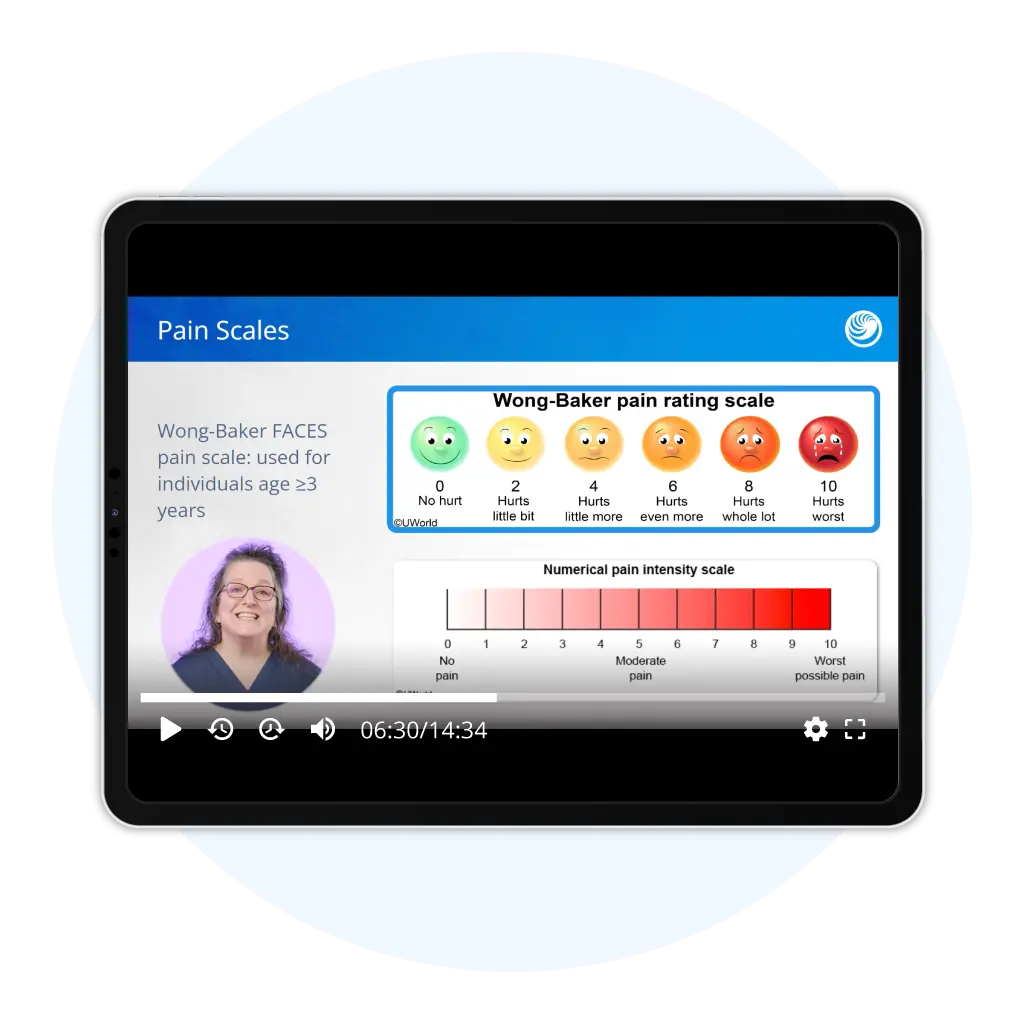
Our videos teach health assessment by grounding every technique in clinical significance. We clearly contrast normal and abnormal findings to reduce the overwhelm of memorizing procedural steps.
- Closed captions and transcripts included
- Ideal for pre-lab or flipped classrooms
- Visual normal vs. abnormal comparisons
Live Comprehension Checks
Launch pre-built quizzes of 5 to 7 NGN-style questions directly during lecture. Check comprehension before lab or debrief immediately after skills practice.
- No quiz-building required before lab
- Real-time response distribution visible
- Gradebook updates automatically
Ready-to-Teach Slide Decks
Access fully editable slide decks organized by body system and nursing implications. Personalize content or assign for pre-lab review without starting from scratch.
- Saves hours of prep across lab sections
- Ensures consistent multi-faculty delivery
- Recordable for asynchronous programs
Confidence for Lab Faculty
Concise bulleted outlines align perfectly with every PowerPoint deck. These notes help new or adjunct faculty facilitate unfamiliar assessment topics accurately and consistently.
- Aligned directly to every slide deck
- Perfect for part-time or adjunct faculty
- Reduces delivery variability across cohorts
Guides for Complex Systems
UGuides simplify complex assessments with visual organizers and step-by-step sequences. Built-in questions confirm retention before students enter the lab.
- Reduces cognitive load on complex systems
- Pairs perfectly with independent study
- Check-for-understanding questions included
Develop Clinical Reasoning
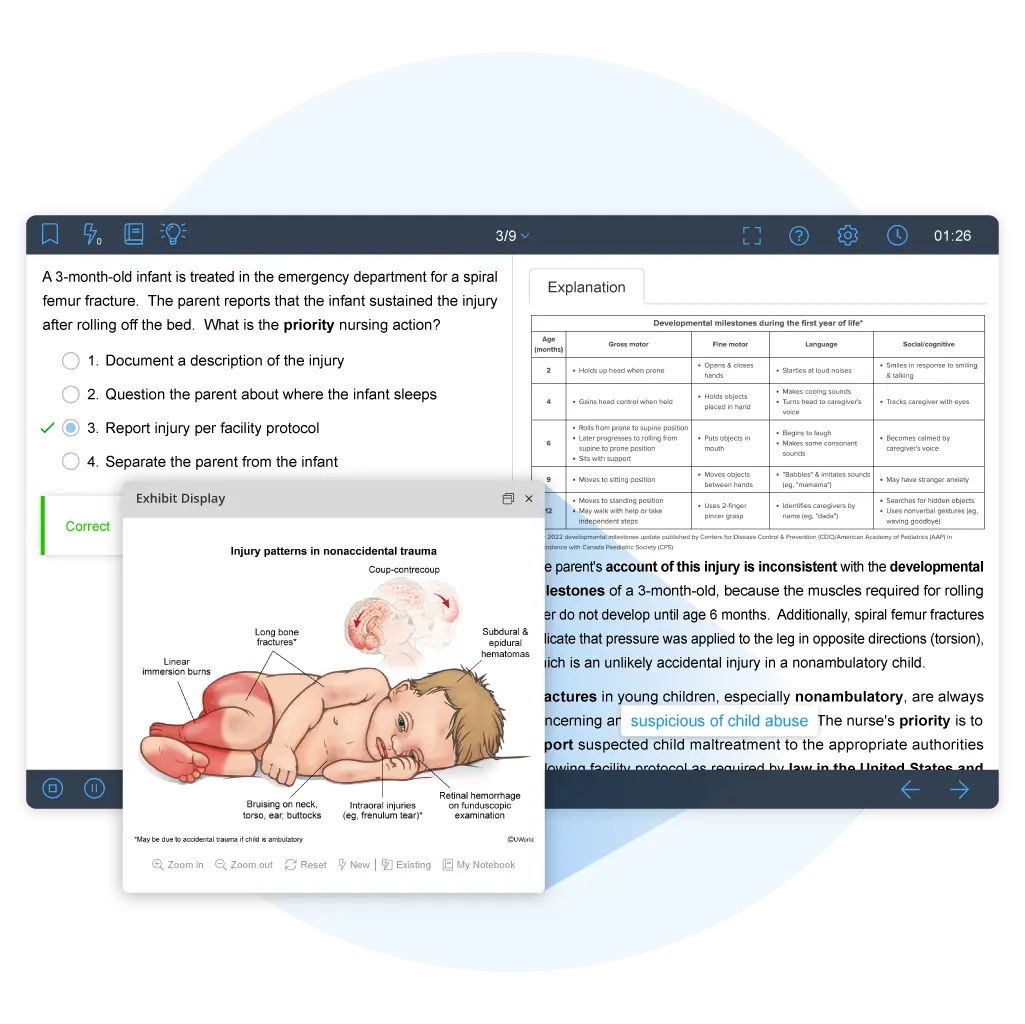
Assign practice questions built to move students from basic technique to clinical reasoning. Detailed rationales explain what findings mean and what to do next.
- Aligned directly to lecture and UGuides
- Interprets findings instead of listing steps
- Ideal for pre-lab prep or remediation
Build Custom Assessments
Access a faculty-exclusive question bank to create targeted quizzes and evaluations. Filter items by body system, clinical concept, or client needs category.
- Exclusive access separate from students
- Filter by body system or clinical concept
- NGN-style and reasoning items included
Comprehensive Health Assessment Evaluations
Validate program readiness with two comprehensive, never-before-seen health assessment evaluations. Available in RN and PN versions aligned to key instructional standards.
- RN and PN versions included at no extra cost
- Secure and timed for assessment integrity
Support Students, Faculty, and Program Leaders in One Course
Teach Confidently with Less Prep
Access ready-to-use teaching resources organized by body system. Assign pre-lab prep, monitor comprehension, and support remediation without sourcing multiple materials.
- Teach without building slides from scratch
- Identify struggling students before clinicals
- Equip adjuncts with ready-to-use resources
Build Skills for Clinical Practice
Provide resources that move beyond procedural checklists. Findings-first videos and NGN-style cases build the interpretive skills students need for clinicals and the NCLEX®.
- Move from procedural steps to deep understanding
- Empower students to track performance by system
- Prepare cohorts with NGN-aligned practice
Standardize Assessment Instruction Across Your Program
Program leaders gain visibility into course delivery, student performance by body system, and curriculum alignment documentation, all in one platform. Consistent teaching resources reduce the variability that comes from each faculty member or lab instructor building their own materials and teaching their own version of head-to-toe assessment.
- Deliver a consistent physical assessment experience regardless of who is teaching the section
- Enter accreditation review with outcomes documentation already organized, not assembled under deadline pressure
- Reduce dependence on individual faculty choices to maintain assessment course quality across the department
Documentation That Supports Program Review
reports
Support Before, During, and After Adoption
Physical Assessment Topics Across 15+ Body Systems
Skills
Assessment
Gastrointestinal Assessment
Program Leaders and Faculty Share Their Experience
Faculty Experience
Student Learning Impact
Program Review Support
See How UWorld's Physical Assessment Course Fits Your Program
One Platform. Every Role. Every Stage of the Course
| Feature | UWorld Physical Assessment | Traditional resources |
|---|---|---|
|
Course format
|
Modular digital course organized by body system with integrated clinical interpretation. | Lab manuals and skills checklists focused on procedural steps without findings-based reasoning. |
|
Content updates
|
Date-stamped, regularly updated to reflect current assessment standards and NCLEX blueprint changes. | Printed lab guides that require new editions or manual faculty updates between cycles. |
|
Findings interpretation
|
Integrated into every module — normal versus abnormal, clinical significance, and nursing response. | Technique-focused instruction that treats interpretation as a separate clinical skill. |
|
Platform
|
Faculty tools and student resources in one connected platform. | Teaching materials, lab guides, and question banks managed across separate systems. |
|
Role-based access
|
Built for students, faculty, and program leaders simultaneously. | Primarily student-facing with limited faculty reporting or program-level visibility. |
|
AACN alignment
|
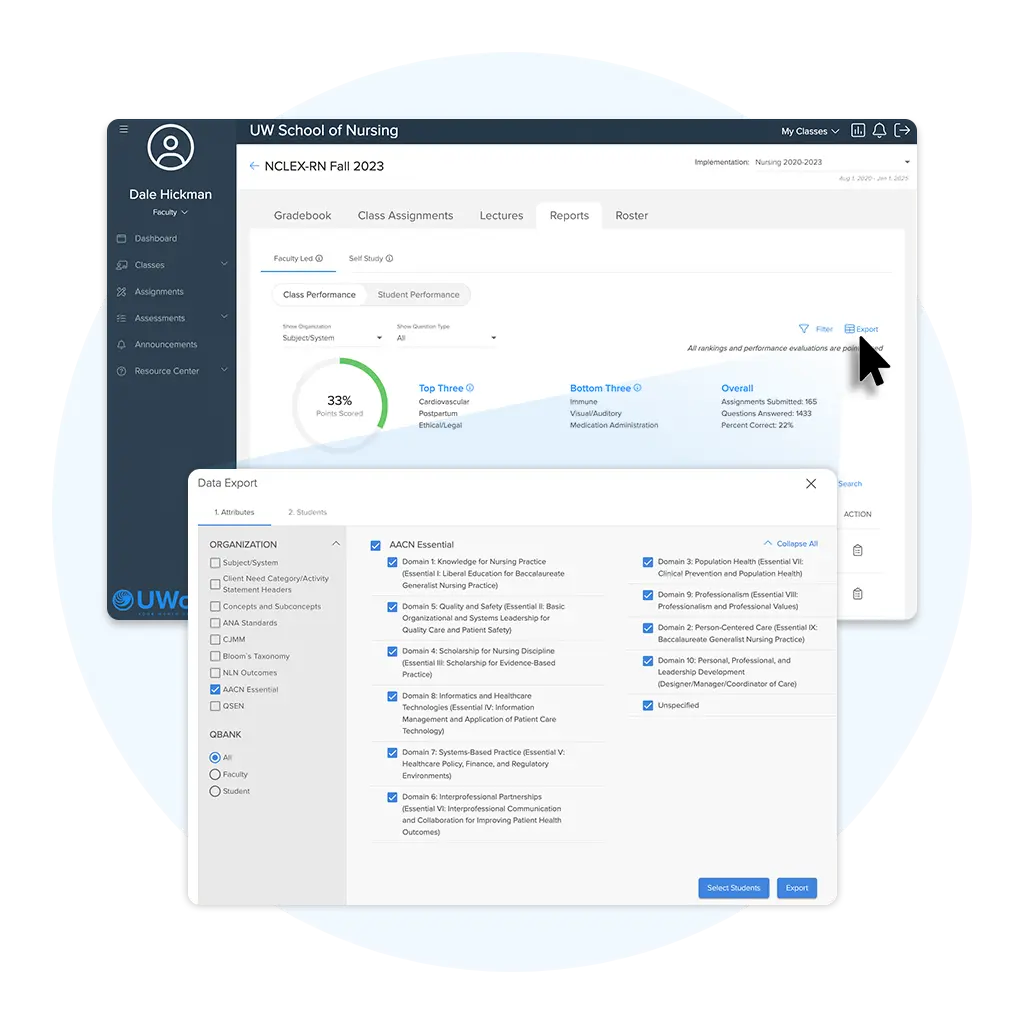
Filterable by domain with domain-mapped performance reports. | Static alignment tables with no domain-level reporting. |
|
Accreditation docs
|
Built-in evidence package available on request. | Programs build documentation manually from separate sources. |
|
Remediation
|
Performance data organized by body system flows directly into targeted review and tracking. | Managed manually and typically triggered after lab evaluations confirm the gap. |
|
Program flexibility
|
Supports LPN/LVN, ADN, BSN, and Accelerated BSN without separate course builds. | Fixed structures that require supplementation across program types and delivery formats. |
Course Format
âś” Modular digital course organized by body system with integrated clinical interpretation.
âś– Lab manuals and skills checklists focused on procedural steps without findings-based reasoning.
Content Updates
âś” Date-stamped, regularly updated to reflect current assessment standards and NCLEX blueprint changes.
âś– Printed lab guides that require new editions or manual faculty updates between cycles.
Findings Interpretation
✔ Integrated into every module — normal versus abnormal, clinical significance, and nursing response.
âś– Technique-focused instruction that treats interpretation as a separate clinical skill.
Platform
âś” Faculty tools and student resources in one connected platform.
âś– Teaching materials, lab guides, and question banks managed across separate systems.
Role-Based Access
âś” Built for students, faculty, and program leaders simultaneously.
âś– Primarily student-facing with limited faculty reporting or program-level visibility.
AACN Alignment
âś” Filterable by domain with domain-mapped performance reports.
âś– Static alignment tables with no domain-level reporting.
Accreditation Docs
âś” Built-in evidence package available on request.
âś– Programs build documentation manually from separate sources.
Remediation
âś” Performance data organized by body system flows directly into targeted review and tracking.
âś– Managed manually and typically triggered after lab evaluations confirm the gap.
Program Flexibility
âś” Supports LPN/LVN, ADN, BSN, and Accelerated BSN without separate course builds.
âś– Fixed structures that require supplementation across program types and delivery formats.
Physical Assessment FAQs
How is UWorld's Physical Assessment course different from a traditional nursing textbook?
UWorld Physical Assessment is a digital-first course built for active learning, clinical interpretation, and nursing-specific judgment, not a procedural reference organized around skills checkoff lists. All content is date-stamped and regularly updated so faculty and students always work with current assessment guidance rather than waiting on a new lab manual edition. Unlike static procedure guides, the platform connects lecture videos, UGuides, practice questions, NGN-style case studies, and assessments in one place. Faculty can assign by body system, track student performance in real time, and identify comprehension gaps before lab evaluations confirm them. Students get structured visual resources that build findings-based reasoning from normal assessment through abnormal finding recognition and clinical response.
How does UWorld teach Physical Assessment content?
Every body system module in the course is taught through a consistent clinical reasoning framework that connects assessment technique to findings interpretation and nursing action. Rather than presenting procedural steps in isolation, each module grounds technique in clinical significance, what the nurse is looking for, what normal and abnormal look like, and what the findings mean for patient care priorities.
This approach helps students build the observational and interpretive reasoning that transfers to actual patient encounters rather than just skills lab competency. When a student understands what an adventitious breath sound indicates, they can reason through an unfamiliar presentation at the bedside rather than defaulting to a memorized list. The same framework applies to every body system across the course, so students develop a consistent approach to assessment that carries through every clinical rotation.
Does the course support both RN and PN programs?
Yes. UWorld Physical Assessment includes RN-specific and PN-specific practice questions and course assessments, making it appropriate for ADN, BSN, Accelerated BSN, and LPN/LVN programs. Content is scoped to pre-licensure nursing assessment responsibilities, with PN-version materials aligned to practical nursing scope and PN NCLEX readiness. Programs that run both RN and PN tracks can use the same platform with role-appropriate content assignments and separate assessment versions for each program type.
How does the course align with AACN Essentials?
UWorld Physical Assessment is aligned with the AACN Essentials framework, with content mapped to relevant domains and key concepts across assessment, clinical judgment, and person-centered care. Faculty can filter assignments by AACN domain and generate reports that map student and cohort performance to those domains, making outcomes documentation more organized during curriculum review or accreditation preparation. AACN Essentials mapping guides are available on request, and UWorld can provide documentation to support self-study preparation, site visits, and ongoing program review conversations.
Can the course be used to prepare students before lab sessions?
Yes, and this is one of the most common ways faculty use it. Lecture videos and UGuides are designed for pre-lab assignment so students arrive already familiar with the assessment sequence and what findings to expect. This frees lab time for hands-on practice, clinical reasoning discussion, and instructor-guided feedback rather than content delivery. Faculty using the course in a flipped format report stronger lab engagement and better quality post-lab discussions when students have completed the UWorld module in advance.
What faculty teaching tools are included?
Faculty have access to a full set of ready-to-use teaching resources designed to reduce preparation time and support consistent instruction across every section and instructor. This includes editable PowerPoint slides with instructor notes aligned to every body system module, pre-built lecture quizzes and polling tools for lab and lecture use, a Faculty QBank for creating custom evaluations, and two comprehensive end-of-course assessments for RN and PN versions. The gradebook and customizable reporting tools give faculty visibility into student and cohort performance by body system throughout the term.
How does UWorld support students who are struggling with physical assessment?
The platform gives faculty visibility into student performance at the body system, assignment, and cohort level, so students with assessment gaps can be identified and supported earlier in the term rather than after a clinical evaluation confirms the problem. Faculty can use performance data to assign targeted review, direct students to specific UGuides or videos for a given system, and track whether focused remediation is having an effect. Students can also use the platform independently to revisit body systems where they are weakest, review rationales, and complete additional practice. This combination of faculty-directed and self-directed remediation supports programs in closing assessment gaps before students reach clinical placement.
Does the course connect physical assessment to clinical decision-making?
Yes. UWorld Physical Assessment integrates clinical interpretation and decision-making throughout every body system module rather than treating them as separate course outcomes. Each lesson connects assessment findings to their clinical significance, what a third heart sound indicates, when an abnormal respiratory rate warrants priority intervention, how neurologic changes map to patient deterioration risk. Students do not just learn how to assess, they learn what the findings mean and what comes next. This integration builds the kind of assessment-informed judgment that the NCLEX tests and clinical practice requires from day one.
Does the course support accreditation documentation?
Yes. UWorld Physical Assessment includes built-in support for accreditation preparation. Available documentation includes AACN Essentials mapping, assessment alignment to learning standards, CJMM case study evidence, cohort performance reports, and content currency documentation covering update cycles and clinical accuracy. A structured evidence package is available on request and can be tailored to support curriculum review, self-study preparation, or site visit conversations. Faculty and program leaders do not need to build physical assessment-specific documentation from scratch, UWorld provides materials to demonstrate alignment, outcomes, and instructional quality as part of the accreditation process.
Can I view sample content before adopting the course?
Yes. Educators can request a walkthrough or access sample physical assessment content before making any commitment. The walkthrough covers the full course interface including the student learning experience, faculty teaching tools, assignment workflows, gradebook, and reporting features. Sample content includes lecture videos, UGuides, NGN-style case studies, and practice questions across representative body system modules. This gives faculty and program leaders a clear picture of how UWorld fits their physical assessment curriculum, teaching workflow, and program goals before adoption decisions are made. Walkthroughs can be scheduled for individual faculty or for department-wide review sessions.
Is the course appropriate for programs integrating health assessment across multiple courses?
Yes. Programs that teach physical assessment as a standalone course and then reinforce it across subsequent clinical courses, Med-Surg, Maternal-Newborn, Pediatrics, Mental Health, will find the modular, body-system organization well-suited to selective assignment across the curriculum. Faculty can assign specific system modules to supplement clinical coursework without rebuilding assessment content for each course. This makes UWorld Physical Assessment useful beyond the first semester, supporting assessment skill reinforcement throughout the pre-licensure curriculum wherever clinical judgment around patient findings is a learning objective.