Child Health Nursing for Nurse Educators
Traditional pediatric textbooks can't keep up with today's clinical demands. UWorld Child Health delivers an 18-unit digital curriculum designed for every nursing program type with faculty resources, age-specific learning tools, and coverage from growth and development through acute care.
Why Are Child Health Programs Shifting from a Textbook?
- Vital ranges misapplied to pediatrics
- Pacing wrong for infants and toddlers
- Families sidelined in patient care
- Airway/hydration/sepsis priorities weak
- Pediatric placements harder to secure
- Class/simulation carry most of the load
- Students arrive at clinical unprepared
- Lecture alone can't fill the gap
- Weight-based dosing errors are high-risk
- Parent comms need structured practice
- Emergencies escalate faster than adults
- Inconsistent teaching risks patients
Everything Your Child Health Course Needs in One Platform
High-Yield. Built for Pediatric Learners.
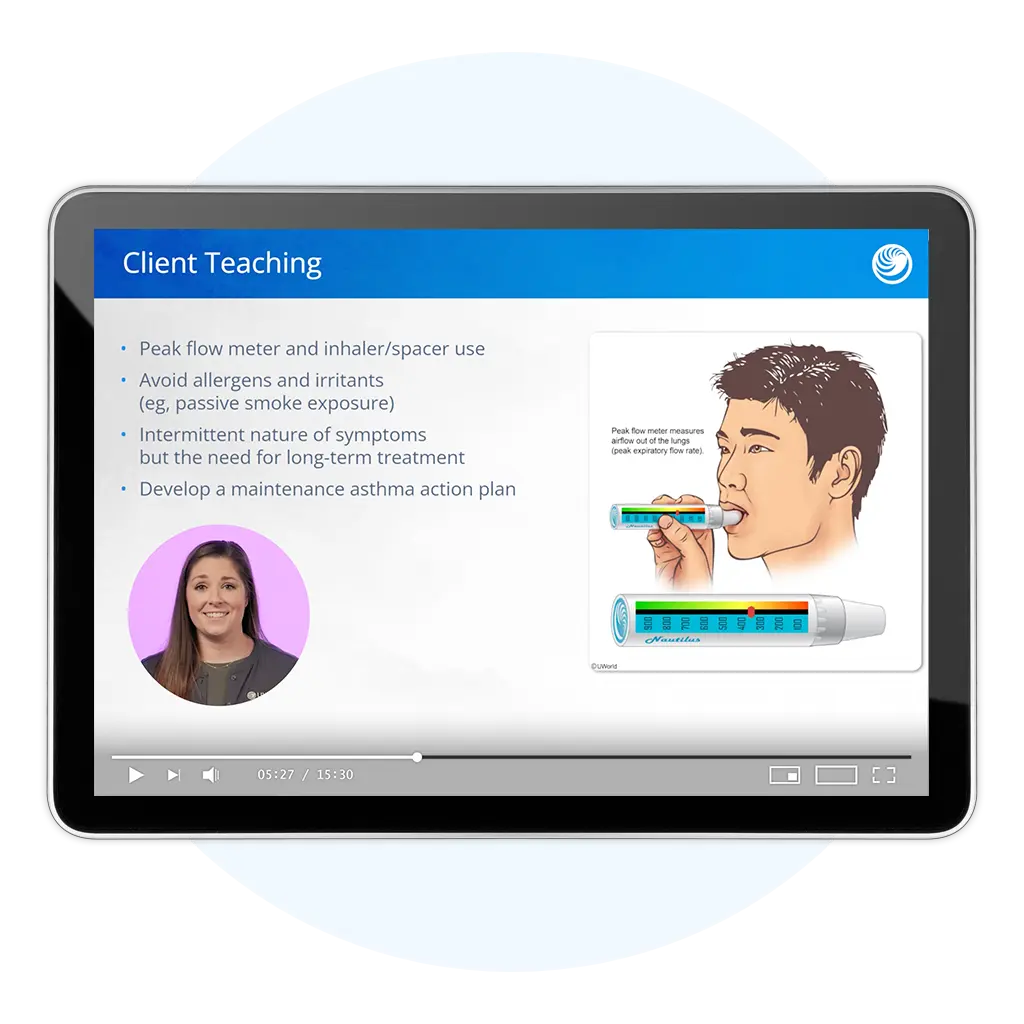
Pediatric video lectures organized by developmental stage and condition, covering growth and development, assessment, family-centered care, respiratory, cardiac, GI, neurologic, and pediatric emergencies.
- Short, focused segments
- Developmentally appropriate visuals and demonstrations
- Assignable by topic or module
Quick Checks. After Every Lecture.
Short formative quizzes confirm students grasp pediatric content before moving into deeper application.
- Aligned to lecture objectives
- Built for low-stakes pre- or post-lecture use
- Reported into the faculty dashboard
Complex Topics. Clearly Explained.
Visual study guides organized by condition and developmental stage, giving students a focused review that complements or replaces a pediatric textbook.
- Concept-based, not chapter-based
- Includes pediatric tables, growth charts, and visual aids
- Linked to practice questions and NGN case studies
Real Scenarios. Detailed Rationales.

Application-focused questions that push students into pediatric reasoning, from recognizing dehydration in an infant to supporting families through chronic illness.
- Scenarios across all developmental stages
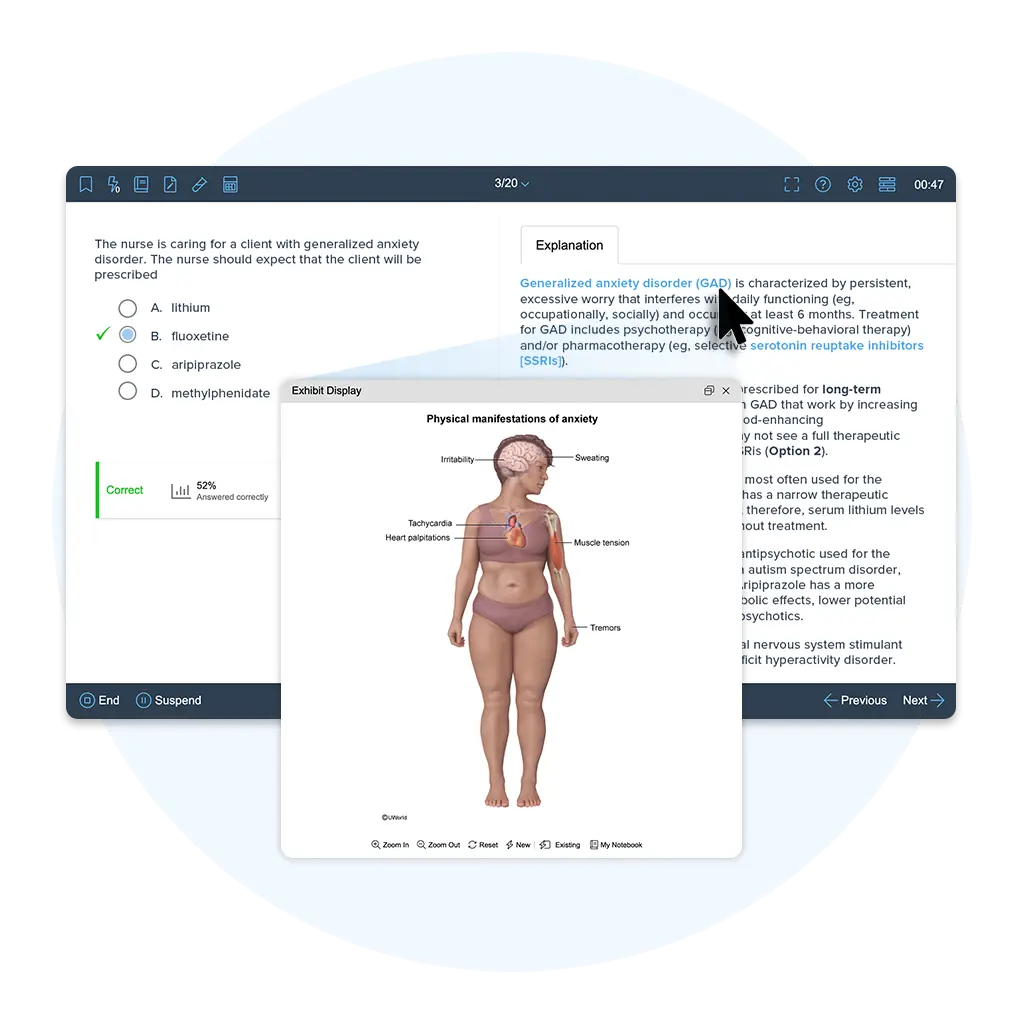
- Rationales with images and growth references
- Aligned to pediatric prioritization and family-centered care
All CJMM Steps. Every Case.
Evolving pediatric scenarios that place students inside real clinical situations and ask them to demonstrate judgment at every step.
- Bowtie, matrix, drag-and-drop, and cloze items
- Pediatric-specific evolving scenarios
- Linked to the NCSBN Clinical Judgment Measurement Model
Support for pediatric faculty, students, and program leaders
Teach Pediatrics Confidently. Every Section.
Videos, slides, instructor notes, NGN case studies, and a Faculty QBank, everything faculty need to deliver consistent pediatric instruction, whether they're seasoned or stepping in mid-semester.
- Slide decks with built-in instructor notes
- Faculty QBank separate from student practice
- Section-level reporting to track what's working
Think Like a Pediatric Nurse
Developmentally focused lectures, UGuides, and NGN-style practice build the clinical reasoning students need before they ever enter a pediatric unit.
- Mobile-friendly content built for pediatric learning
- Rationales that include developmental and family context
- Family-centered care woven throughout every topic
See the Full Pediatric Picture
Pediatric-specific reporting gives program leaders the data they need for accreditation review, curriculum decisions, and early intervention where students are falling behind.
- Cohort and section performance reporting
- Topic-level mastery tracking
- Accreditation-ready data
Pediatric Documentation That Supports Program Review
evidence
reports
A team that supports pediatric course adoption end to end
Child Health Topics Across Core Nursing Concepts
Oncologic
Genitourinary
High-Acuity Care
Educators On Adopting UWorld For Pediatric / Child Health
Faculty Experience
Student Learning Impact
Program Review Support
See How Child Health Fits Your Program
UWorld Pediatric vs. traditional pediatric resources
| Feature | UWorld Child Health | Other Providers |
|---|---|---|
|
Format
|
Modular, integrated 18-unit digital course. | Static, often outdated textbook chapters. |
|
Updates
|
Continuous, date-stamped guidelines. | Infrequent manual updates (2–4 years). |
|
NGN/Clinical Judgment
|
130+ cases; 500+ practice questions. | Limited, retrofitted recall questions. |
|
Age-Specific Reasoning
|
Woven into all topics. | Siloed, early-chapter content. |
|
Pathophysiology
|
Linked to clinical application. | Disconnected, separate chapters. |
|
Platform
|
Unified faculty/student system. | Fragmented systems. |
|
Visibility
|
Full program-level insights. | Primarily student-facing. |
|
Reporting
|
Filterable, domain-mapped data. | Static tables only. |
|
Assessment
|
Exclusive, secure final exam included. | No exams included. |
|
Evidence
|
Built-in CJMM mapping package. | Manual documentation required. |
Format
✔ Modular, integrated 18-unit digital course.
✖ Static, often outdated textbook chapters.
Updates
✔ Continuous, date-stamped guidelines.
✖ Infrequent manual updates (2–4 years).
NGN/Clinical Judgment
✔ 130+ cases; 500+ practice questions.
✖ Limited, retrofitted recall questions.
Age-Specific Reasoning
✔ Woven into all topics.
✖ Siloed, early-chapter content.
Pathophysiology
✔ Linked to clinical application.
✖ Disconnected, separate chapters.
Platform
✔ Unified faculty/student system.
✖ Fragmented systems.
Visibility
✔ Full program-level insights.
✖ Primarily student-facing.
Reporting
✔ Filterable, domain-mapped data.
✖ Static tables only.
Assessment
✔ Exclusive, secure final exam included.
✖ No exams included.
Evidence
✔ Built-in CJMM mapping package.
✖ Manual documentation required.
Child Health Course FAQs
How is UWorld's Child Health course different from a traditional pediatric textbook?
UWorld Child Health is a digital-first course built for active learning, application, and assessment of pediatric content. All material is date-stamped and regularly updated, so faculty and students always work with current pediatric clinical guidance including evolving immunization schedules, weight-based dosing standards, and AAP recommendations rather than waiting on a new textbook edition.
Unlike static chapters, the platform connects videos, UGuides, practice questions, NGN-style case studies, quizzes, and a final exam in one place. Faculty can assign by topic, system, unit, or learning objective, track student performance in real time, and adjust instruction based on data. Students get structured, visual resources that help them understand complex pediatric concepts before, during, and after class from congenital cardiac defects through age-specific behavioral assessment. The result is a more connected course experience with less content sprawl and greater consistency across pediatric sections.
How does UWorld teach Child Health content?
Every condition in the course is taught through the same five-step clinical reasoning framework, applied consistently across all 18 systems and units. Rather than presenting isolated facts, each topic walks students through the condition the way a pediatric nurse thinks at the bedside, connecting disease mechanisms to clinical presentation, nursing action, and family teaching in a single structured sequence.
Step 1 is Pathophysiology. Students start with what is happening at the cellular and organ level adjusted for the pediatric population, where immature physiology, growth, and developmental considerations change the picture. Without this foundation, students memorize signs and symptoms without understanding what is driving them in a child.
Step 2 is Risk Factors. Students learn who develops this condition and why, with explicit attention to age, gestational history, family history, and environmental exposures. This builds the screening lens that helps nurses identify high-risk pediatric patients before complications develop a core clinical judgment skill the NCLEX tests directly.
Step 3 is Manifestations. Students learn how the condition presents in a child, including age-specific vital sign ranges, labs, behavioral signs, and complications. Pediatric presentation often differs from adult presentation, and this step is where that difference is taught explicitly.
Step 4 is Interventions. Students learn what to do and in what order, covering priority pediatric nursing actions, weight-based pharmacology dosing, surgical care, and family involvement. This step connects clinical reasoning directly to safe pediatric patient care decisions.
Step 5 is Client Teaching. Students learn discharge education and self-care guidance for both the child and the family, preparing them for the full scope of pediatric nursing where the patient and the caregiver are educated together.
While not every pediatric topic follows every step, this framework is applied to every condition across all 18 systems and units, so students are not just learning content. They are building a repeatable way of thinking that transfers to new patient scenarios, unfamiliar conditions, and NGN-style pediatric case questions that require clinical judgment rather than recall.
Can UWorld support a complete pediatric nursing course?
Yes. UWorld Child Health covers 18 systems and units with topic-based organization, ready-to-assign teaching resources, and comprehensive final-exam support designed to carry programs through a full Pediatrics or Child Health course. Faculty can build or revise syllabi using assignable videos, UGuides, practice questions, NGN case studies, quizzes, and an auto-graded secure final exam all aligned to program learning objectives.
The course is organized to support sequential delivery across a single pediatric course or to be integrated into combined Maternal-Child or Lifespan courses. Whether programs are building a new pediatric sequence or replacing an existing textbook bundle, UWorld provides the content, tools, and structure to support the full curriculum without requiring faculty to source materials from multiple platforms.
Does the course include pathophysiology?
Yes. Pediatric pathophysiology is integrated throughout every topic rather than treated as a standalone module. Each lesson connects underlying disease mechanisms to clinical signs, age-specific symptoms, nursing interventions, and patient and family outcomes whether the topic is Tetralogy of Fallot, hypertrophic pyloric stenosis, sickle cell disease, cystic fibrosis, or bacterial meningitis. Students do not just learn what to do but why, which reinforces pediatric clinical reasoning, supports retention, and builds the kind of judgment needed for NCLEX-style decision-making.
This integrated approach also helps faculty teach pediatric pathophysiology in context rather than in isolation, making it easier for students to apply concepts across different patient scenarios and age groups.
Is the course appropriate for traditional and accelerated programs?
Yes. UWorld Child Health is designed to support LPN/LVN, ADN, BSN, and Accelerated BSN programs. Most materials can be used for both RN and PN content; scope varies on a small number of topics, and faculty can readily address those discrepancies. The course is organized by system, unit, and topic, which gives faculty flexibility to sequence content, adjust pacing, and scale assignments to match program timelines.
For accelerated programs, faculty can prioritize high-yield pediatric topics, compress pacing, and assign targeted practice without rebuilding course materials from scratch. For traditional semester-based programs, the full course structure supports a complete Pediatrics or Child Health course. In both cases, the platform supports consistent delivery regardless of how many instructors are teaching across sections.
Does the course include NGN case studies and practice questions?
Yes. UWorld Child Health includes 130+ NGN-style pediatric case studies and application-based practice questions built to reflect the clinical decision-making demands of the Next Generation NCLEX. Rather than testing recall, these items ask students to prioritize, analyze, and act within realistic pediatric patient scenarios that unfold across multiple steps including unfolding cases for high-yield topics such as pediatric respiratory distress, oncologic emergencies, and congenital cardiac defects.
This format helps students build the clinical judgment skills they need both in the classroom and on the exam. Faculty can assign NGN items by topic, system, or unit, use them as formative assessments, or integrate them into course sequences to reinforce lesson content. Detailed rationales accompany every item so students understand the reasoning behind correct and incorrect responses.
How does the course align with AACN Essentials?
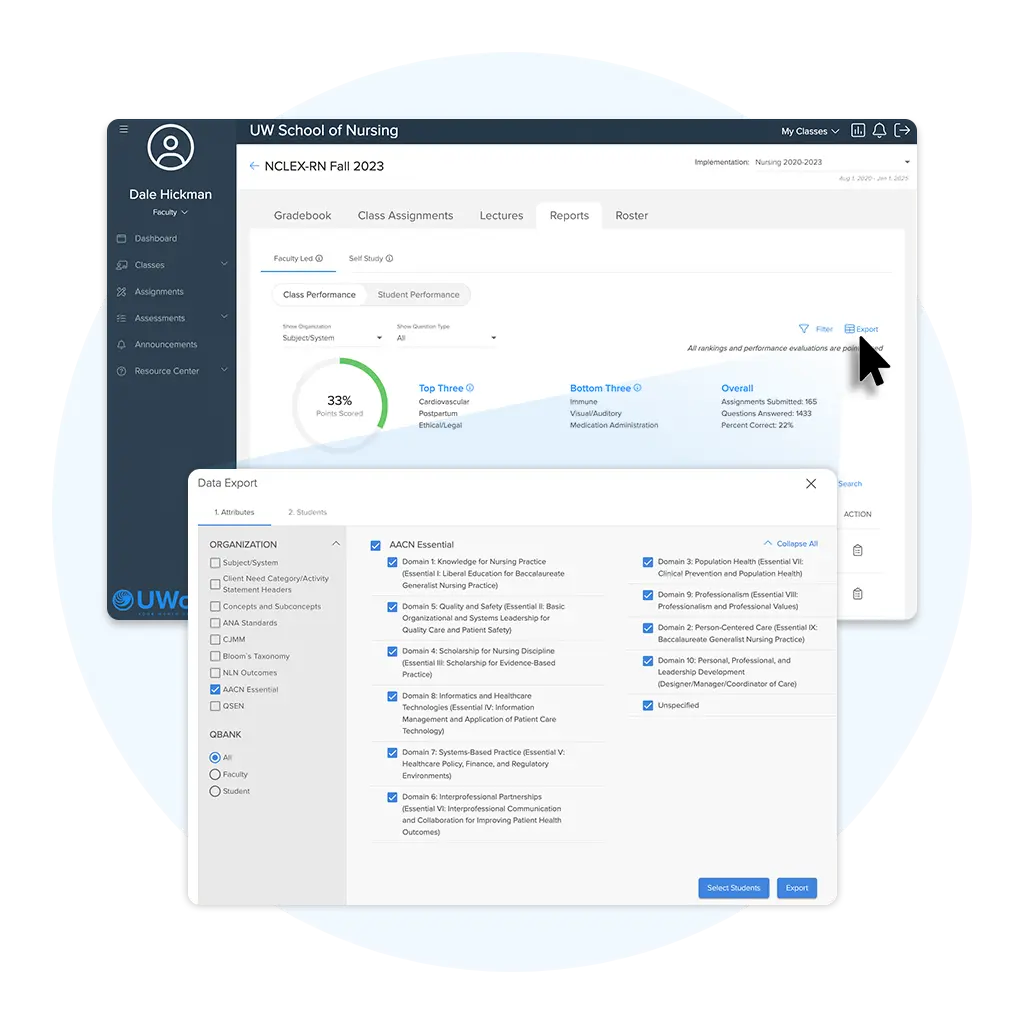
UWorld Child Health is fully aligned with the AACN Essentials, including featured domains and key concepts across the framework. Faculty can filter assignments by AACN domain and generate reports that map student and cohort performance to those domains making outcomes documentation more straightforward during curriculum review or accreditation preparation for pediatric content.
The course also integrates active learning strategies throughout, consistent with the competency-based education approach emphasized in the current Essentials framework. AACN Essentials mapping guides are available on request, and UWorld can provide documentation to support self-study preparation, site visits, and ongoing program review conversations.
What faculty teaching tools are included?
Pediatric faculty have access to a full set of ready-to-use teaching resources designed to reduce prep time and support consistent instruction across sections. This includes editable PowerPoint slides with instructor notes, pre-built lecture quizzes and polling tools, a Faculty QBank for building custom assessments, and a secure comprehensive final exam.
The gradebook and customizable reporting tools give faculty visibility into student, topic, system, and cohort performance throughout the term. Resources are designed to support both full-time faculty and adjunct or part-time instructors who may be picking up a pediatric section mid-program. Everything is available within the same platform students use, so assignments, feedback, and performance data stay connected rather than scattered across separate tools.
Does UWorld provide training and support?
Yes. UWorld provides structured support at every stage of adoption. Before the term begins, live and on-demand onboarding helps pediatric faculty configure the platform, set up assignments, and get comfortable with gradebook and reporting tools. During the term, dedicated support is available for assignment management, grading questions, and product issues so faculty are not troubleshooting alone mid-semester.
Faculty and students can also access a self-serve Resource Center within the application at any time, with tutorials, setup guides, product updates, and FAQs. For programs adopting UWorld across multiple courses or sections, implementation support helps coordinate rollout and ensure a consistent launch experience across the department.
Can I view sample content before adopting the course?
Yes. Educators can request a walkthrough or access sample content before making any commitment. The walkthrough covers the full course interface including the student learning experience, faculty teaching tools, assignment workflows, gradebook, and reporting features.
Sample content includes video lessons, UGuides, NGN-style pediatric case studies, and practice questions across representative Child Health topics typically including a high-yield respiratory or cardiac case to demonstrate the course’s clinical judgment focus. This gives faculty and program leaders a clear picture of how UWorld fits their curriculum, teaching workflow, and program goals before adoption decisions are made. Walkthroughs can be scheduled for individual faculty or for department-wide review sessions.
Does the course support accreditation documentation?
Yes. UWorld Child Health includes built-in support for accreditation preparation. Available documentation includes AACN Essentials mapping, assessment alignment to learning standards, CJMM case study evidence, cohort performance reports, and content currency documentation that covers update cycles and clinical accuracy.
A structured evidence package is available on request and can be tailored to support curriculum review, self-study preparation, or site visit conversations specific to pediatric content. Faculty and program leaders do not need to build this documentation from scratch. UWorld can provide the materials needed to demonstrate alignment, outcomes, and instructional quality as part of the accreditation process.
How does UWorld handle content updates?
All content in UWorld Child Health is date-stamped and reviewed on a regular update cycle to reflect current pediatric clinical guidelines, pharmacology changes, immunization schedule revisions, and NCLEX blueprint updates. Faculty do not need to audit or patch individual lessons when guidelines change. Updates are applied to the platform directly, so students always work with accurate, current information.
This is particularly important for Child Health content, where weight-based dosing thresholds, immunization schedules, AAP recommendations, and developmental screening guidelines can shift between textbook editions. Programs that move from a traditional pediatric textbook to UWorld typically gain a multi-year buffer against curriculum drift.
Can the course be integrated into our existing LMS?
UWorld Child Health is designed to work within nursing program workflows. Integration options and LMS compatibility details are available during the walkthrough. Programs can discuss how assignments, gradebook data, and reporting outputs connect with their existing systems. Contact UWorld to review integration options specific to your program’s setup.
How does UWorld support students who are struggling with pediatric content?
The platform gives faculty visibility into student performance at the topic, system, assignment, and cohort level so struggling pediatric students can be identified earlier in the term rather than after a failed assessment. Faculty can use performance data to assign targeted review, direct students to specific UGuides or videos, and track whether remediation is having an effect.
Students can also use the platform independently to revisit weak topics, review rationales, and complete additional pediatric practice particularly useful for high-yield, high-difficulty content like congenital cardiac defects, pediatric oncology, and age-specific assessment. This combination of faculty-directed and self-directed remediation support helps programs address pediatric content gaps before they affect course outcomes or NCLEX readiness.
Is UWorld Child Health appropriate for programs undergoing curriculum revision?
Yes. Programs revising their pediatric or Child Health curriculum, transitioning to competency-based education, or updating materials to reflect the current AACN Essentials framework will find UWorld Child Health well-suited to support that process. The course arrives with AACN domain mapping, NGN-aligned pediatric assessments, and a system- and unit-based organization that adapts to different sequencing models including integration into combined Maternal-Child or Lifespan courses.
Faculty can use the existing course structure as a starting point or selectively assign content to fill gaps in a revised pediatric curriculum. UWorld’s implementation team can also support programs working through curriculum transition by helping map existing course objectives to available pediatric content.