Pharmacology Built for Nursing Educators
Move students from rote memorization to safe medication administration. UWorld provides LPN to BSN programs with everything needed to drive Next Generation NCLEX® success while significantly reducing faculty prep time.
Pharmacology Requires More Than a Static Textbook
- Short-term recall, limited retention
- Students struggle to apply concepts
- Gaps in reasoning risk patient safety
- Tools must build real application
- Slides and banks live in silos
- Curating content drains faculty time
- Inconsistent multi-faculty delivery
- Adjuncts need ready-to-teach prep
- Weak performance hidden until exams
- Cohort gaps missed in real time
- Remediation happens after failure
- Need data by topic and drug class
A Complete Pharmacology Teaching Ecosystem
Foundational Concepts in Focus
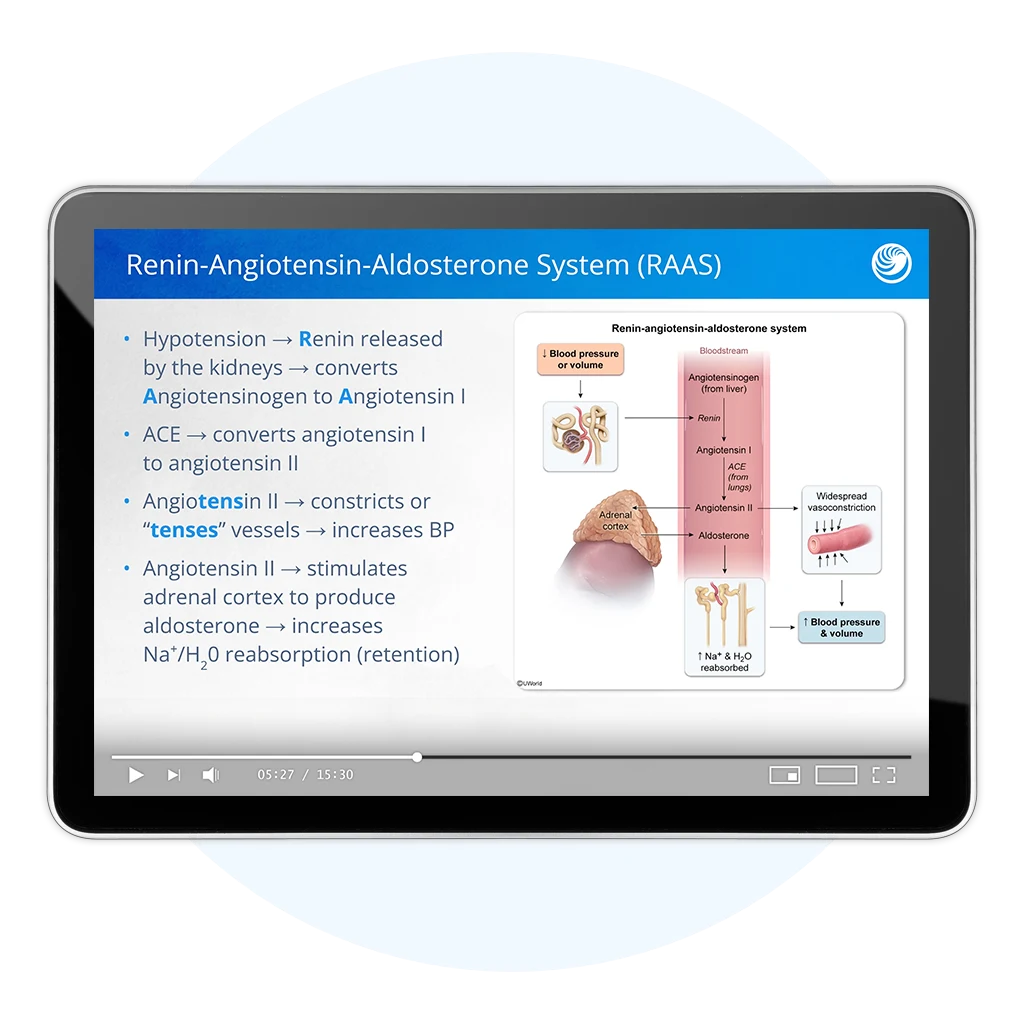
Our expert-led videos teach each drug class starting with a mechanism of action. We connect foundational concepts to nursing implications to prevent cognitive overload.
- Closed captions and transcripts included
- Built for flipped or traditional classrooms
- Mnemonics reinforce classification patterns
Built-In Comprehension Checks
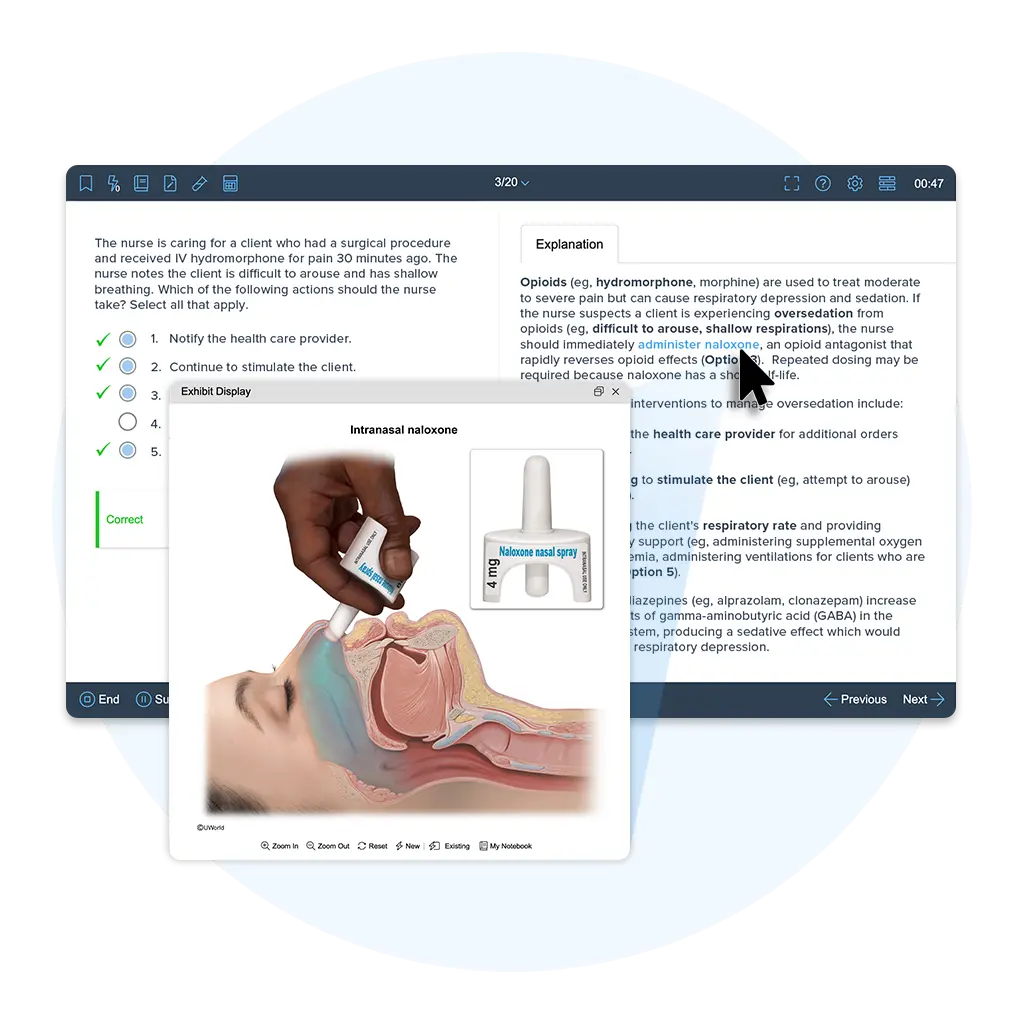
Check student understanding quickly with pre-built, auto-graded lecture quizzes. Confirm that students grasp foundational drug concepts before moving them into high-level application.
- Auto-graded for immediate feedback
- Gradebook updates automatically
- Ideal for dense cardiovascular or psych topics
Ready-to-Teach Presentations
Access fully editable slide decks organized by drug classification and mechanism. Personalize content or assign for pre-class review without starting from scratch.
- Saves hours of prep across sections
- Ensures consistent multi-faculty delivery
- Recordable for asynchronous programs
Step-In Confidence for Faculty
Concise bulleted outlines align perfectly with every PowerPoint deck. These notes help new or part-time faculty teach unfamiliar drug classes with accuracy.
- Aligned directly to every slide deck
- Perfect for part-time or adjunct faculty
- Reduces delivery variability across cohorts
Visual Guides for Complex Drugs
UGuides simplify complex topics with visual organizers and mechanism-of-action diagrams. Built-in questions confirm retention before students move forward.
- Reduces overload on complex classifications
- Pairs perfectly with independent study
- Check-for-understanding questions included
Clinical Reasoning in Every Item

Assign practice questions aligned directly to lecture content. Detailed rationales explain both correct and incorrect options to build lasting clinical judgment.
- Aligned directly to lecture and UGuides
- Connects drug action to patient presentation
- Ideal for homework or targeted remediation
Build Custom Assessments Quickly
Access a faculty-exclusive question bank to create targeted assignments. Filter pharmacology items by drug class, body system, or client needs category.
- Exclusive access separate from students
- Filter by classification or organ system
- NGN-style and reasoning items included
Support Students, Faculty, and Program Leaders in One Course
Teach Confidently with Less Prep
Access ready-to-use teaching resources organized by drug classification. Assign practice, monitor comprehension, and support targeted remediation without sourcing multiple materials.
- Teach without building slides from scratch
- Identify struggling students before exams
- Provide consistent materials for all faculty
Build Skills for Clinical Practice
Provide structured resources that move beyond memorization. Mechanism-first videos and NCLEX-style practice build the reasoning skills needed for the NCLEX and the clinical floor.
- Move from rote lists to deep understanding
- Empower students to track their performance
- Prepare cohorts with active learning tools
Standardize Your Pharmacology Course
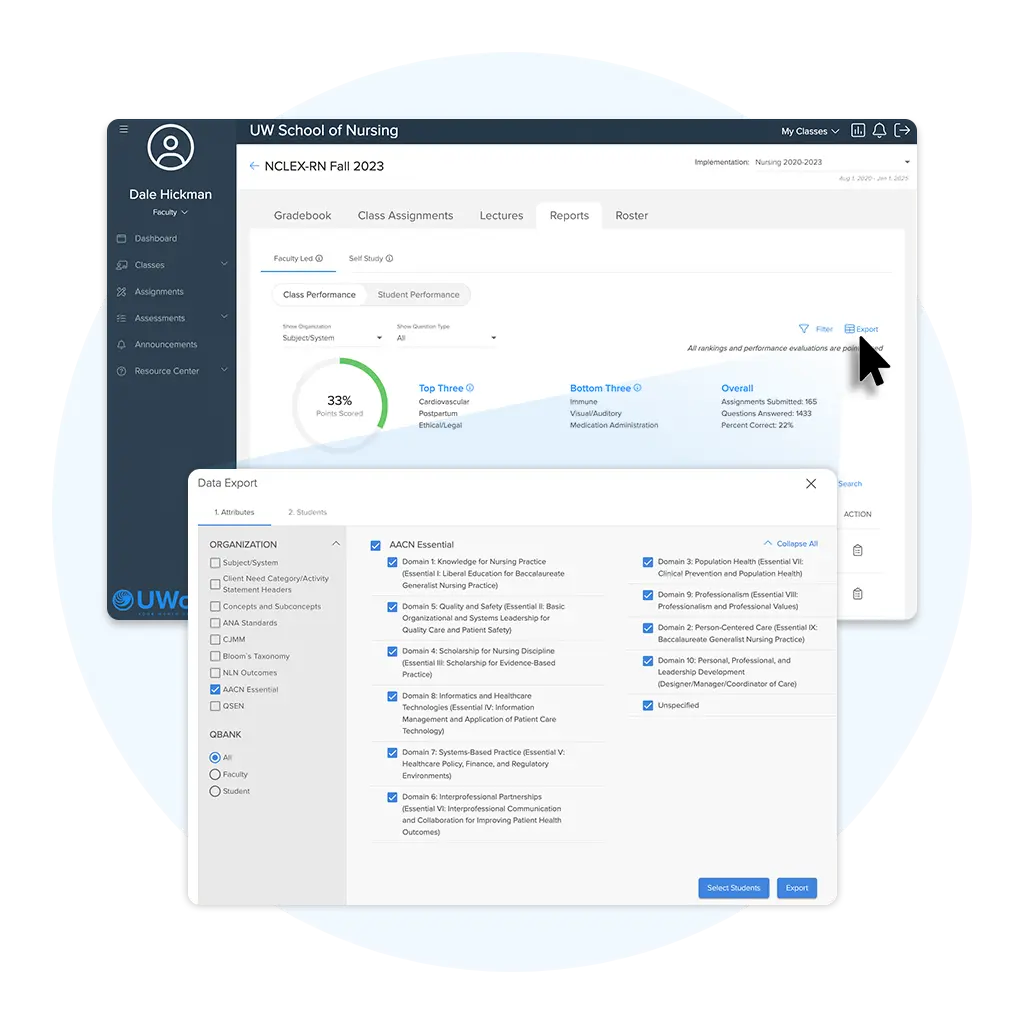
Gain instant visibility into course delivery, student performance, and curriculum alignment. Consistent teaching resources reduce the variability of faculty building their own materials.
- Ensure consistency across all instructors
- Access pre-built AACN mapping documents
- Reduce variability in overall course quality
Streamline Your Program Review
Alignment
reports
Support Before, During, and After Adoption
Pharmacology Topics Across Major Drug Classifications
Educators On Adopting UWorld For Pharmacology
Faculty Experience
Student Learning Impact
Program Review Support
See How UWorld's Pharmacology Course Fits Your Program
How UWorld Pharmacology Compares To A Traditional Textbook
| Feature | UWorld Pharmacology | Traditional resources |
|---|---|---|
|
Course format
|
Modular digital course organized by drug classification and body system. | Static textbook chapters or isolated drug card supplements. |
|
Content updates
|
Date-stamped, regularly updated to reflect current clinical guidelines and NCLEX blueprint changes. | New editions required, with faculty patching materials manually between cycles. |
|
Mechanism of action
|
Integrated into every drug class module before clinical effects and nursing implications. | Listed in appendices or isolated pharmacokinetics chapters disconnected from bedside application. |
|
Platform
|
Faculty tools and student resources in one connected platform. | Teaching materials, question banks, and assessments managed across separate systems. |
|
Role-based access
|
Built for students, faculty, and program leaders simultaneously. | Primarily student-facing with limited faculty or program-level visibility. |
|
AACN alignment
|
Filterable by domain with domain-mapped performance reports. | Static alignment tables with no domain-level reporting. |
|
Accreditation docs
|
Built-in evidence package available on request. | Programs build documentation manually from separate sources. |
|
Remediation
|
Performance data organized by drug class flows directly into targeted review and tracking. | Managed manually and often triggered after failed assessments. |
|
Program flexibility
|
Supports LPN/LVN, ADN, BSN, and Accelerated BSN without separate course builds. | Fixed course structures that require supplementation across program types. |
Course Format
âś” Modular digital course organized by drug classification and body system.
âś– Static textbook chapters or isolated drug card supplements.
Content Updates
âś” Date-stamped, regularly updated to reflect current clinical guidelines and NCLEX blueprint changes.
âś– New editions required, with faculty patching materials manually between cycles.
Mechanism of Action
âś” Integrated into every drug class module before clinical effects and nursing implications.
âś– Listed in appendices or isolated pharmacokinetics chapters disconnected from bedside application.
Platform
âś” Faculty tools and student resources in one connected platform.
âś– Teaching materials, question banks, and assessments managed across separate systems.
Role-Based Access
âś” Built for students, faculty, and program leaders simultaneously.
âś– Primarily student-facing with limited faculty or program-level visibility.
AACN Alignment
âś” Filterable by domain with domain-mapped performance reports.
âś– Static alignment tables with no domain-level reporting.
Accreditation Docs
âś” Built-in evidence package available on request.
âś– Programs build documentation manually from separate sources.
Remediation
âś” Performance data organized by drug class flows directly into targeted review and tracking.
âś– Managed manually and often triggered after failed assessments.
Program Flexibility
âś” Supports LPN/LVN, ADN, BSN, and Accelerated BSN without separate course builds.
âś– Fixed course structures that require supplementation across program types.
Pharmacology Nursing FAQs
How is UWorld's Pharmacology course different from a traditional nursing textbook?
How does UWorld teach pharmacology content?
Every drug class in the course is taught through a consistent clinical reasoning framework that connects mechanism of action to patient outcomes. Rather than presenting drug facts in isolation, each module starts with the pharmacologic principle first, why the drug works at the cellular or receptor level, then moves into therapeutic indications, nursing implications, adverse effects, and patient teaching priorities.
This approach helps students build a transferable reasoning pattern rather than drug-specific memorization. When a student understands how a beta blocker works, they can reason through an unfamiliar beta blocker they have never seen on a label. That is the kind of pharmacologic thinking the NCLEX tests and clinical practice requires, and it applies consistently across every major drug classification in the course.
How does the course align with AACN Essentials?
UWorld Pharmacology is aligned with the AACN Essentials framework, including featured domains and key concepts relevant to pharmacology instruction. Faculty can filter assignments by AACN domain and generate reports that map student and cohort performance to those domains, which makes outcomes documentation more straightforward during curriculum review or accreditation preparation. The course integrates active learning and clinical judgment strategies throughout, consistent with the competency-based approach the current Essentials framework emphasizes. AACN Essentials mapping guides are available on request, and UWorld can provide documentation to support self-study preparation, site visits, and program review conversations.
Does the course support both RN and PN programs?
Yes. UWorld Pharmacology includes RN-specific and PN-specific practice questions and course assessments, making it appropriate for ADN, BSN, Accelerated BSN, and LPN/LVN programs. Content is scoped to pre-licensure nursing practice, with PN-version materials aligned to practical nursing scope and PN NCLEX readiness. Programs that run both RN and PN tracks can use the same platform with role-appropriate content assignments and separate assessment versions for each program type.
Can UWorld Pharmacology support accelerated BSN programs?
Yes. ABSN programs can use UWorld Pharmacology to prioritize high-yield drug classifications, compress pacing using pre-built materials, and assign targeted practice without rebuilding course resources under tight timelines. The course is organized by drug classification and topic, which gives faculty the flexibility to sequence content, adjust assignment density, and scale to compressed semesters. For ABSN programs, UWorld’s structured resources also reduce the burden on individual faculty to build course materials from scratch, which matters more when program timelines leave little room for preparation.
What faculty teaching tools are included?
How does UWorld support students who are struggling with pharmacology?
The platform gives faculty visibility into student performance at the drug class, assignment, and cohort level, so struggling students can be identified earlier in the term rather than after a failed exam. Faculty can use performance data to assign targeted review, direct students to specific UGuides or videos, and track whether remediation is having an effect. Students can also use the platform independently to revisit drug classes where they are weakest, review rationales, and complete additional practice items. This combination of faculty-directed and student-driven remediation supports programs in addressing pharmacology gaps before they affect course outcomes or NCLEX readiness.
Does the course include pathophysiology connections?
Yes. UWorld Pharmacology integrates pathophysiology throughout drug classification instruction rather than treating it as a separate prerequisite topic. Each module connects the underlying mechanism of disease or physiologic dysfunction to the drug’s mechanism of action, so students understand not just what the drug does but why it is the appropriate intervention. This integration is particularly important for complex drug classes like cardiovascular agents, immunosuppressants, and psychiatric medications, where understanding the disease process is essential for anticipating drug effects, recognizing adverse events, and making sound clinical decisions.
Can I view sample content before adopting the course?
Yes. Educators can request a walkthrough or access sample pharmacology content before making any commitment. The walkthrough covers the full course interface including the student learning experience, faculty teaching tools, assignment workflows, gradebook, and reporting features. Sample content includes lecture videos, UGuides, NGN-style case studies, and practice questions across representative drug classifications. This gives faculty and program leaders a clear picture of how UWorld fits their pharmacology curriculum, teaching workflow, and program goals before adoption decisions are made. Walkthroughs can be scheduled for individual faculty or for department-wide review sessions.
Does the course support accreditation documentation?
Yes. UWorld Pharmacology includes built-in support for accreditation preparation. Available documentation includes AACN Essentials mapping, assessment alignment to learning standards, CJMM case study evidence, cohort performance reports, and content currency documentation that covers update cycles and clinical accuracy. A structured evidence package is available on request and can be tailored to support curriculum review, self-study preparation, or site visit conversations. Faculty and program leaders do not need to build pharmacology-specific documentation from scratch, UWorld provides the materials needed to demonstrate alignment, outcomes, and instructional quality as part of the accreditation process.
Is the course appropriate for programs undergoing curriculum revision?
Yes. Programs revising their pharmacology curriculum, transitioning to competency-based education, or updating materials to align with the current AACN Essentials framework will find UWorld Pharmacology well-suited to support that process. The course arrives with AACN domain mapping, NGN-aligned assessments, and drug classification organization that adapts to different sequencing models. Faculty can use the existing course structure as a starting point or selectively assign content to fill specific curriculum gaps. UWorld’s implementation team can also support programs working through curriculum transition by helping map existing course objectives to available pharmacology content.