Updated 2026

Free NCLEX Study Plans & Schedules

Take the Smartest Path to NCLEX Success
Pick a free weekly NCLEX study plan matched to your timeline. Or skip the planning altogether. Just set your exam date, start date, and availability, and generate a personalized day-by-day schedule automatically.

Create a Custom NCLEX Study Plan in Seconds

Everything You Need to Build an NCLEX Study Plan

Passing the NCLEX takes more than knowing nursing content, it takes a deliberate, structured approach to how and when you study. A well-built NCLEX study plan reduces anxiety, prevents burnout, keeps your weaker content areas from falling through the cracks, and puts you in front of the right material at the right time before your exam date.

What to Study for the NCLEX

Before you open a QBank or write a single flashcard, you need to understand what the exam is actually testing, and how much of your score each topic represents. The NCSBN organizes all NCLEX content into a framework called Client Needs, which divides nursing knowledge into 4 major categories and 6 subcategories.

Every question on your exam maps to one of these categories. Check out our NCLEX-RN test plan or NCLEX-PN test plan pages for more details.

High-Priority Content Areas

Beyond the category distribution, there are specific content types that require dedicated attention regardless of your timeline. These aren't the largest sections by percentage, they're the ones that cause the most errors and carry the most clinical judgment complexity.

Dosage Calculations
Students who struggle with calculations consistently underperform on Pharmacology questions, even when they know the drug content.
NGN Bow-Tie Questions
Bow-tie questions require you to identify a condition, select relevant actions, and predict outcomes simultaneously. Master the format early, so it’s not a surprise on exam day.
NGN Case Studies (Unfolding)
The 2026 NCLEX includes three unfolding case study sets of six questions each, all building on a single patient scenario. Clinical reasoning takes weeks to develop, not days.
Pharmacology
Pharmacology is the 2nd largest category (13-19%) and the highest student failure rate. Start it in the first week of any timeline, pattern recognition takes time to build.

How to Study for the NCLEX

Knowing what to study is only half the equation. How you study determines whether that knowledge actually transfers to exam performance under pressure. The evidence is consistent: active retrieval practice, working through exam-style questions and reading detailed rationales, is significantly more effective than passive review methods like rereading notes or watching videos alone.

Our data backs this up. UWorld students achieve a 98% pass rate* on both the NCLEX-RN and NCLEX-PN, based on 10,000+ student surveys from active users who reached target QBank scores of 75% for RN and 74% for PN.

An effective NCLEX prep course should include all of the following, and UWorld delivers every one:

Testing Environment
A testing environment that mirrors the real NCLEX interface, including every NGN question format
Detailed Rationales
Detailed rationales explaining why every answer option is right or wrong, not just the correct one
Lecture Videos
High-yield lecture videos to reinforce concepts you've missed in your QBank
Flashcards
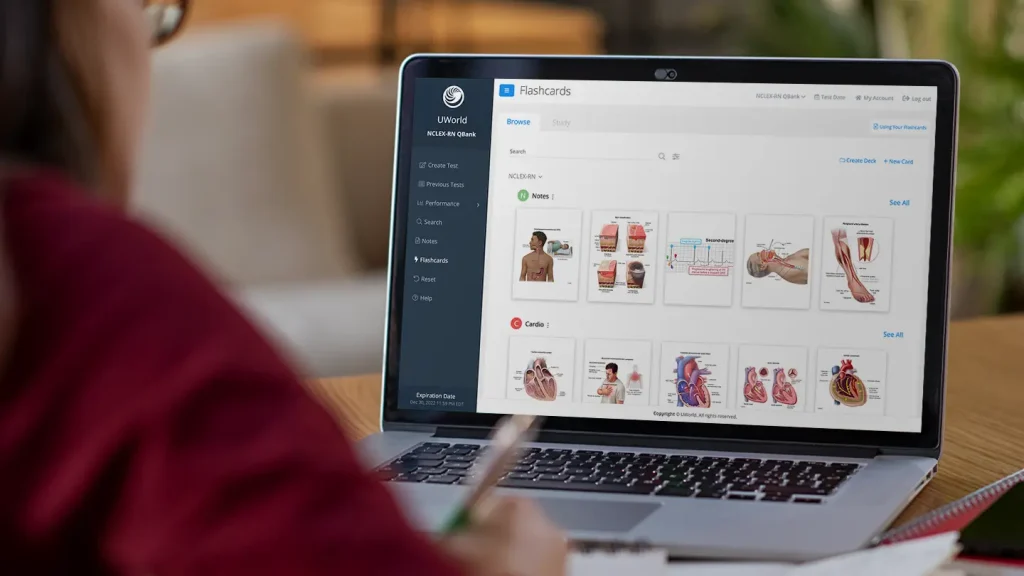
Spaced-repetition flashcards and digital notes for long-term retention
Adaptive Tests
Computerized Adaptive Tests that replicate the real NCLEX algorithm
Self-assessments
Self-assessments with a statistically validated readiness rating: Low, Medium, High, or Very High

Students who don't pass are almost never the ones who studied the wrong content. They're the ones who studied passively, skipped rationales, or ran out of time before finishing their question bank.

Creating an NCLEX Study Plan

Watch Nurse Samantha explain how to kickstart your NCLEX studying with proven tips on scheduling, study habits, and building mental stamina.

Nurse Samantha, BSN, RN — Top NCLEX Study Planning Tips
Play Video about Nurse Samantha, BSN, RN — Top NCLEX Study Planning Tips

Free Weekly NCLEX Study Plans

Pick your timeline below. Each plan includes a strategy overview, daily question targets, time commitment, and a week-by-week content schedule. The content sequencing in every plan is intentional.

2-Week NCLEX Study Plan

4–6 hours/day

600–1,000 questions/week Short breaks/every 90 mins

A 2-week plan is a high-intensity final push, not a from-scratch preparation. It's best suited for repeat test-takers or students who have already completed a comprehensive review course and need to sharpen test-taking strategy and build exam-day stamina. If you are a first-time test-taker who hasn't yet opened a QBank, start with the 4-week plan instead.

Because this timeline offers no runway for content relearning, the focus is entirely on performance under pressure, simulating the real exam environment as closely as possible, as often as possible.

Days Content Focus Daily Questions Milestone
1–2 Take a baseline Self-Assessment. Identify your 3 weakest content areas using your QBank performance data. Do not study broadly, attack only what the data tells you to. 85–100 Baseline Self-Assessment
3–5 Weakest content areas only. Pharmacology if there's a gap. Read every rationale carefully, even on questions you answer correctly. 100–120
6–7 Management of Care, Prioritization, Delegation, Safety. These are the highest-weighted categories and the most commonly missed under time pressure. 100–120 CAT Exam #1
8–10 Mixed-subject blocks. NGN case studies. Alternate-format questions: SATA, matrix, bow-tie. Focus on format fluency, not new content. 120–150 CAT Exam #2
11–13 Full-length CAT exams only. No new content. Treat each one as the real exam: same start time, same conditions, same break schedule. 85–150 Readiness Assessment
14 Rest. Light review of weak-area rationales only. No new questions, no new topics. Exam ready

3 Week NCLEX Study Plan

3-5 hours/day

500–750 questions/week 1 rest days per week

A 21-day timeline is fast-paced but allows slightly more breathing room than the 2-week plan. It's ideal for dedicated students who are treating exam prep like a full-time job immediately after graduation, and who are disciplined enough to stick to a strict daily schedule without external accountability.

Week Content Focus Daily Questions Milestone
1 Baseline Self-Assessment on day one. Brain dump what you already know. Aggressively attack your weakest areas: Pharmacology, Fluids & Electrolytes, Safety & Infection Prevention and Control. 75–100 Baseline Self-Assessment
2 Mixed body systems: Cardiovascular, Respiratory, Neuro, Renal, GI. Add Management of Care and Prioritization questions daily alongside system content. 75–120 CAT Exam #1 + #2
3 Full CAT exams daily. NGN case studies. Final Self-Assessment by day 19. Rest day before exam. 85–120 Readiness Assessment

4 Week NCLEX Study Plan

3-5 hours/day

350–700 (50–100 per day) 1–2 rest days per week

One month is the gold standard for dedicated recent graduates who have cleared their schedule for focused preparation. It provides enough time for a thorough system-by-system review while keeping material fresh for exam day.

The biggest risk with a 4-week plan is falling behind in week 2: the schedule below is designed to prevent that by building in a natural mid-point reset.

Week Content Focus Daily Questions Milestone
Week 1 Fundamentals, Fluids & Electrolytes, Safety & Infection Prevention and Control, Pharmacology basics: drug class logic, high-alert medications, dosage calculations 50–75 Baseline Self-Assessment
Week 2 Cardiovascular, Respiratory, Hematology, Neuro: continue daily pharmacology questions alongside system content 75 CAT Exam #1 — identify weak areas, adjust week 3 focus accordingly
Week 3 Renal, Endocrine, GI, Maternity, Peds, Mental Health: spaced-repetition flashcard review daily for week 1–2 content 75–100 Pharmacology deep-dive block
Week 4 Management of Care, Prioritization, Delegation, NGN case studies, Physiological Adaptation 85–100 2 Readiness Assessment

6 Week NCLEX Study Plan

2-3 hours/day

300–425 (60–85 per day) 1–2 rest days per week

6 weeks is the sweet spot for recent nursing graduates who want thorough preparation without the intensity of a 4-week sprint. It provides enough time for deep system-by-system review while allowing for genuine comprehension rather than memorization.

The biggest challenge at this timeline is retention: material studied in week one will begin to fade by week four without active reinforcement.

Week Content Focus Daily Questions Milestone
Week 1 Fundamentals, Safety & Infection Prevention and Control, Fluids & Electrolytes, Acid-Base balance, Pharmacology basics 60–85 Baseline Self-Assessment
Week 2 Cardiovascular, Respiratory, Hematology: lecture videos for complex pathophysiology, daily pharmacology questions 60–85 CAT Exam #1
Week 3 Neuro, Renal, Endocrine, Musculoskeletal: begin spaced-repetition flashcard review of weeks 1–2 content 60–85 Lecture video reinforcement
Week 4 GI, Maternity, Peds, Pharmacology deep-dive: dosage calculations, high-alert meds, drug interactions 60–85 CAT Exam #2
Week 5 Mental Health, Management of Care, Prioritization, Delegation: mixed alternate-format questions daily 75–85 Alternate-format question focus
Week 6 NGN case studies, full CAT exams, targeted remediation of weak areas only 75–85 2 Readiness Assessments

9 Week NCLEX Study Plan

2 hours/day

250–375 (50–75 per day) 2 rest days per week

Nine weeks is highly effective for students who are working part-time, taking a post-graduation trip, or managing family commitments alongside exam prep. The moderate pace allows for genuine comprehension of complex nursing topics without the mental fatigue that derails shorter timelines. At 2-hours per day, this plan is sustainable alongside a part-time work schedule.

Weeks Content Focus Daily Questions Milestone
Weeks 1–2 Fundamentals, Safety, Fluids & Electrolytes, Nutrition, Pharmacology intro: drug classes, administration principles, dosage calculations 50–75 Baseline Self-Assessment + digital notes
Weeks 3–4 Cardiovascular, Respiratory, Hematology, Neuro: lecture videos for complex pathophysiology 50–75 CAT Exam #1
Weeks 5–7 Renal, Endocrine, GI, Musculoskeletal, Maternity, Peds: daily flashcard review of all prior content 50–75 CAT Exam #2
Week 8 Mental Health, Management of Care, Pharmacology deep-dive: generate tests using only your incorrect and omitted questions 50–75 Remediation block
Week 9 NGN case studies, full CAT exams, final Self-Assessment 50–75 2 Readiness Assessments

12 Week NCLEX Study Plan

1–2 hours

150–250 (30–50 per day) 2 rest days per week

Three months offers the most manageable pace for full-time workers, parents, or repeat test-takers who need to rebuild foundational knowledge from the ground up. At one to two hours per day, it fits within almost any schedule.

The primary challenge at this timeline is retention, material from month one will fade significantly without a deliberate spaced-repetition strategy, which is why flashcards are non-negotiable here.

Month Content Focus Daily Questions Milestone
Month 1 Foundational concepts: Fundamentals, Safety & Infection Prevention and Control, Fluids & Electrolytes, Pharmacology basics, Nutrition. Begin spaced-repetition flashcards from day one. 30–50 Baseline Self-Assessment
Month 2 System-by-system review: Cardiovascular through Mental Health. Daily flashcard review runs alongside all new content to prevent month one material from fading. 40–50 CAT Exams #1 and #2
Month 3 Full-length simulated readiness tests, NGN case studies, targeted remediation of weak areas identified in CAT exams 50 2 Readiness Assessments

12 Week+ NCLEX Study Plan

30–45 minutes

75–125 (15–25 per day) 2–3 rest days per week

The ultimate slow-and-steady approach. This timeline is designed for 2 specific groups: students in their final semester of nursing school who want a head start before graduation, and Internationally Educated Nurses who are preparing for the NCLEX while navigating credential verification, English language requirements, and an unfamiliar testing format simultaneously.

For both groups, the goal in the early months is not NCLEX preparation, it's building the foundational clinical knowledge base that makes NCLEX preparation effective later.

Phase Content Focus Daily Questions Milestone
Months 1–2 Align with nursing school syllabus. Study NCLEX content alongside coursework — Fundamentals, Pharmacology basics, Safety. Treat UWorld questions as an extension of daily homework. 15–25 Baseline Self-Assessment
Months 3–4 Continue system-by-system alongside school — Cardiovascular, Respiratory, Neuro. Add spaced-repetition flashcards daily. Focus on understanding the "why" behind every rationale. 15–25 CAT Exam #1
Months 5–6 Post-graduation transition. Shift to 30–50 questions per day. NGN case studies. Begin treating study sessions as dedicated NCLEX prep rather than coursework extension. 25–50 CAT Exam #2 + Readiness Assessment
Final 4 weeks Follow the 4-week plan above exactly 50–100 2 Readiness Assessments

Build Your Personalized NCLEX Study Plan in Seconds

Join the 98% who pass the first time with UWorld. Get a dynamic study planner that adapts to your NCLEX study schedule. We provide the roadmap to success, all you have to do is start studying.

NCLEX Advice from Nurses Who’ve Passed

Short video of UWorld Nurse, Maya, sharing study tip
Play Video about Short video of UWorld Nurse, Maya, sharing study tip
Conquer NCLEX without burnout! Nurse Maya shares her advice for managing test stress through self-care & mindset mastery.

Short video of UWorld Nurse, Holly, sharing study tip
Play Video about Short video of UWorld Nurse, Holly, sharing study tip
Study smarter, not harder! Nurse Holly shares advice on building an NCLEX study plan that includes goals & rewards to keep you motivated.

Frequently Asked Questions

The best NCLEX study schedule matches your timeline, targets your weak areas, and keeps you practicing exam-style questions every single day. Our data shows students who reach a target UWorld NCLEX QBank score of 75% for RN or 74% for PN and achieve a High or Very High self-assessment score pass the NCLEX 98% of the time.

Use the weekly timeline selector above to find the right free NCLEX study plan template for your exam date, then take a baseline self-assessment to confirm your starting point. Or, use our study planner to generate a personalized, daily study plan.

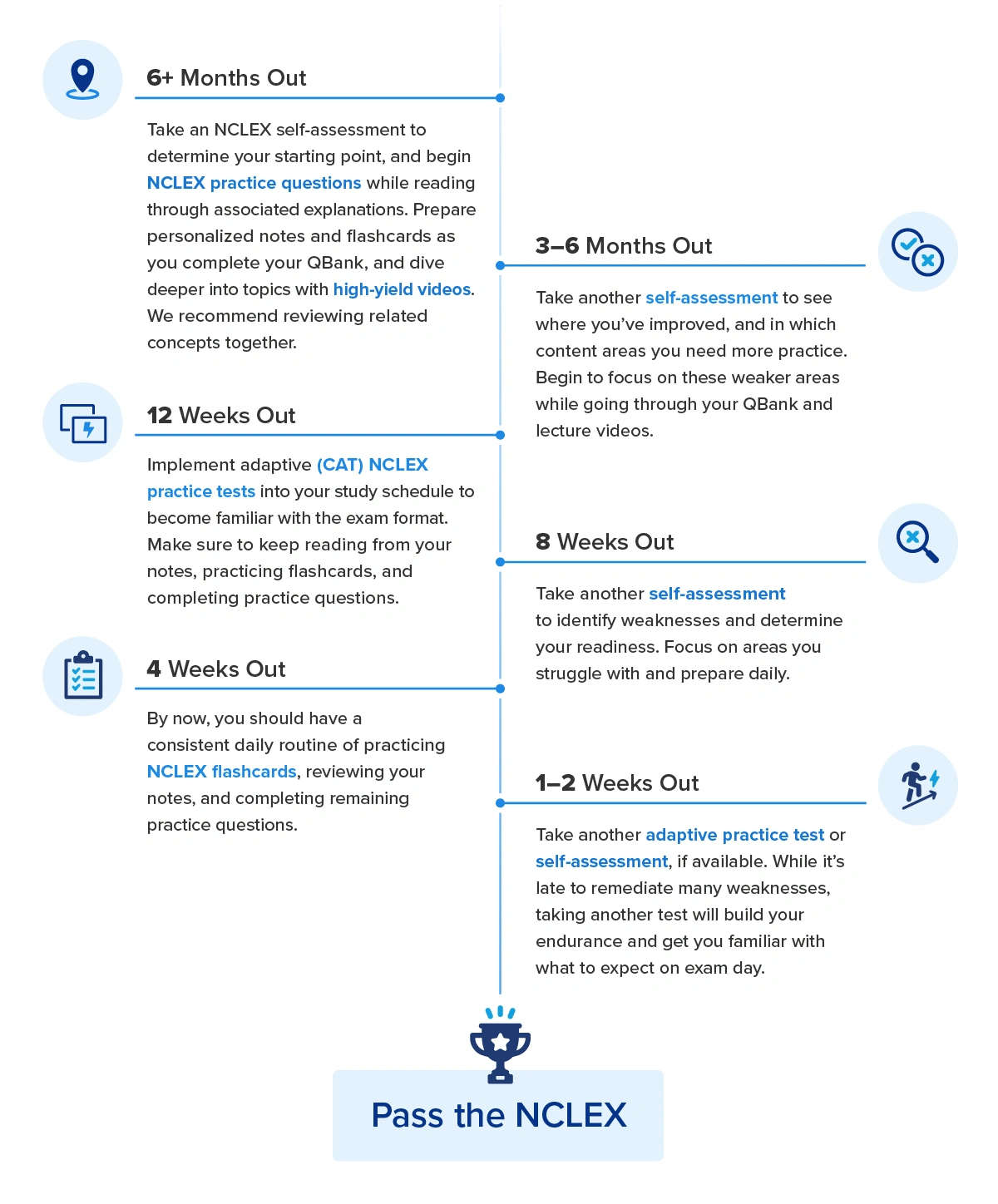
Our nursing educators recommend starting your NCLEX preparation plan during nursing school, approximately 1 to 6 months before your projected exam date. This gives you time to learn the exam format, turn your weaknesses into strengths, and build test-taking endurance gradually. If you’re closer to your exam date, use the free NCLEX study plan timelines above to find the right fit for the time you have. Note that you may require more study time if you’re an internationally educated nurse, or you work full time.

It depends on your timeline. Here is a general breakdown of what to expect:

  • 2-week plan: 4–6 hours per day.
  • 4-week plan: 3–5 hours per day.
  • 60-day to 90-day NCLEX study plan: 1 to 2 focused hours per day.
  • 12+ week plan: 30–45 minutes daily (ideal for integrating with nursing school).

The most important variable isn’t hours; it’s consistency. Daily practice at moderate volume outperforms weekend cramming at high volume every time.

Yes, but only under the right conditions. A 2-week study plan for the NCLEX is a high-intensity final push best suited for repeat test-takers or students who have already completed a comprehensive review course. It is not recommended for first-time test-takers starting from scratch. If you’re unsure whether 2 weeks is enough runway, take a baseline self-assessment first. A High or Very High result means 2 weeks may be sufficient; a Low or Borderline result means you need more time.

For a dedicated recent graduate who can clear their schedule, a 30-day or 4-week NCLEX study plan is the gold standard. It provides enough time for a thorough system-by-system review while keeping material fresh for exam day. The key is strict daily adherence. 4 weeks leaves very little margin for missed study days. If you’re working part-time or managing family commitments, consider a 6-week or 8-week NCLEX study schedule instead.

Balancing work and prep is highly achievable with a 60-day or 90-day timeline, which requires only 1–2 focused hours per day. Try these strategies:

  • Split your sessions: Study in two 45-minute blocks rather than one long session to improve retention.
  • Study on the go: Use the UWorld mobile app on your commute or lunch break.
  • Commit to daily practice: Even 30 minutes of focused question review is more effective than a 4-hour session once a week.

Start with your weakest areas, not the ones you already know. Take a UWorld baseline self-assessment or complete your first QBank block, then sort your results by the lowest-performing category. For most students, the highest-yield starting points are:

  • Pharmacology
  • Fluids and Electrolytes
  • Management of Care

These are the 3 categories that combine high exam weight with high student failure rates.

Divide the total number of questions in your QBank by the number of days until your exam, that’s your daily target. Budget 5–7 minutes per question, including rationale review. Our schedules range from 15–25 questions per day on a 3-month NCLEX study plan to 85–150 per day on a 2-week plan. Quality matters more than quantity. A student who reads every rationale carefully on 50 questions will consistently outperform a student who rushes through 150.

An NCLEX study plan is a free framework or template any student can follow regardless of which prep product they use. The UWorld Study Planner is the adaptive scheduling tool built into the UWorld QBank. It automatically generates a personalized, day-by-day NCLEX study schedule based on your exam date and weekly availability, tracks your progress in real time, and adjusts as you go. The plans tell you what to do; the Planner does the scheduling for you.

Having a template is a great first step, but how you execute your daily NCLEX study schedule is what actually builds clinical judgment. To maximize your retention and avoid burnout, we recommend breaking your daily study blocks into three distinct phases:

  • Review (15–30 mins): Start by reviewing spaced-repetition flashcards or digital notes from the previous day to ensure you are retaining older material.
  • Practice (1–2 hours): Dedicate the bulk of your time to working through QBank questions. Treat this like the real exam by putting away your notes and minimizing distractions.
  • Remediate (1–2 hours): Spend just as much time reviewing your results as you did taking the practice block. Reading the detailed rationales for every answer option, even on questions you guessed correctly, is one of the most effective NCLEX preparation strategies you can implement.

Read More About the NCLEX

NCLEX Exam Information
Learn the structure and format of the NCLEX-RN and NCLEX-PN exams, including their length, how many questions there are, and other important information.
NCLEX Eligibility, Registration, and Cost
View our guide on NCLEX registration. We’ll walk you through when you’re eligible, how to sign up, applicable fees, and specific policies you’ll need to know.
NCLEX Scoring Guide
The NCLEX is a computerized adaptive test (CAT). Dive into what this means, and how new partial-credit scoring will impact your exam results.
NCLEX-RN Test Plan
Explore essential resources within the comprehensive NCLEX-RN Test Plan. Uncover content areas, subcategories, and summaries to gain essential insights.
NCLEX-PN Test Plan
Uncover essential insights within the comprehensive NCLEX-PN Test Plan. Explore content domains, subtopics, and summaries to guide your preparation effectively.
*98% of NCLEX test-takers passed the exam after scoring an average QBank score of 75% on NCLEX-RN and 74% on NCLEX-PN.
View More...
Scroll to Top
Your scrubs are waiting.

Join the 98% who
pass the first time.

Loading form, please wait...