At a Canadian nursing education conference, a familiar question arises: “What does cultural reconciliation look like in practice as an educator?”
A dean answers that, for her, it means changing practices so more Indigenous scholars participate in decision-making. A nurse educator adds that it means recognizing multiple worldviews as valid forms of scholarly knowledge. A clinical instructor explains that, for her, it means rethinking placements so students learn alongside Indigenous health partners rather than about them.
Weeks later, the same question surfaces again in the classroom. A student asks, “What does reconciliation look like in practice as a nurse?”
One student in acute care says it means noticing how bias can appear in documentation. Another in community health says it means understanding how place, culture, and wellness are connected. For a student in rural practice, it means collaborating with community leaders to build shared knowledge and foster mutual respect.
Reconciliation Looks Different Everywhere, Because It Is
Cultural reconciliation takes a different shape in every nursing program because each institution stands on different land with a different history. That individual history influences everything: how communities form relationships with local healthcare systems, how trust is built or broken within those systems, what populations are served, which health disparities are most visible, and what conditions nurses encounter most often. This piece focuses on what cultural reconciliation asks of nursing educators and institutions, recognizing that Indigenous communities define their own priorities, meanings, and pathways for reconciliation.1
Reconciliation begins with developing a local schema. It asks caretakers to recognize that every healthcare program operates within a living network of land, people, and memory that continues to define it. During the past decade, nursing education has sought to translate that awareness into structured practice, one that respects the unique histories of the communities being served while preparing nurses to care equitably for each population.
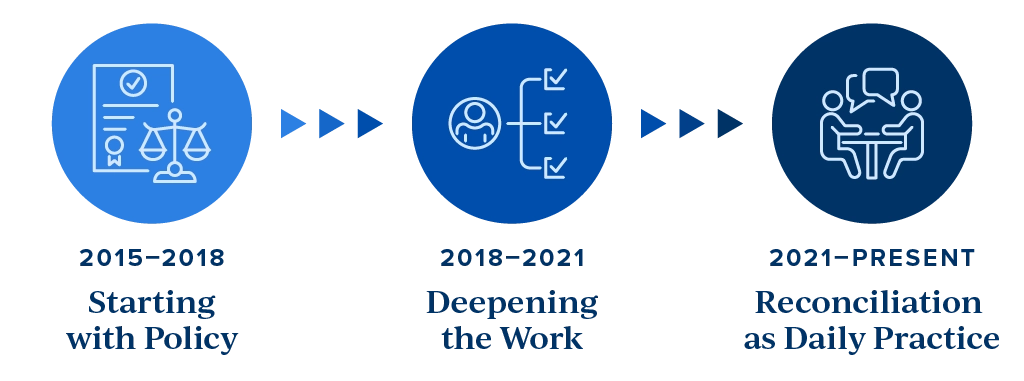
Starting with Policy: 2015-2018
In 2015, the Truth and Reconciliation Commission of Canada: Calls to Action marked a turning point for nursing education in Canada. The commission named the health inequities created by colonial systems and, through Calls to Action 23 and 24, placed explicit responsibility on health systems and medical and nursing schools to address these issues. Across the country, nursing programs began developing visible commitments to this work, including policy frameworks, accreditation updates, and statements affirming the inclusion of Indigenous perspectives in health education.
This early wave of activity carried urgency and good intention, but much of it remained procedural. The tendency to universalize this work, and to apply broad checklists or standardized curriculum goals, risks separating the idea of reconciliation from its origins. Educators began to recognize that policies alone could not determine what reconciliation should look like in different regions.2
Deepening the Work: 2018-2021
In the following years, the work became more tangible as programs began to face their individual history. Nursing institutions began forming partnerships with Indigenous organizations, hosting elders-in-residence, and co-developing curricula rooted in local knowledge systems. Reflection became more central: Educators examined how colonial assumptions persisted in grading, evaluation, and the language used in patient documentation.
Programs began embedding Indigenous case studies into clinical courses and redesigning placements to incorporate community-based learning. Faculty development also expanded, with training sessions and peer discussions encouraging educators to recognize how their teaching methods and evaluation standards reflected the inherited colonial structures.3
Reconciliation as Daily Practice: 2021-Present
By 2021, reconciliation had evolved beyond formal initiatives and had become an integral part of the daily fabric of nursing education. It now shapes how case studies are written, how placements are chosen, and how institutions share authority and credit with Indigenous partners.
Today, educators are increasingly recognizing that reconciliation cannot be achieved solely through broad institutional goals. The work depends on sustained attention to the specific: the histories of local Nations, the land on which programs are built, and the distinct health priorities of nearby communities. Here, learning is reciprocal. Students and faculty engage with communities to understand health as a collective process grounded in shared responsibility.4
Join the Movement: Cultural Reconciliation at Your Institution
As cultural reconciliation becomes embedded in national nursing standards, the next challenge lies in bringing it into daily academic and clinical practice. Educators want to build reconciliation-focused curricula, foster inclusion, and meet national expectations, but often lack the time, training, or confidence to initiate these efforts.
Programs that incorporate collaborative efforts with local Nations, Elders, and Indigenous faculty foster learning that reflects both geography and community needs. Elders and Knowledge Keepers, who are respected teachers and stewards of Indigenous knowledge and traditions, offer cultural, historical, and spiritual guidance when actively included in teaching.5
Most Canadian universities and colleges have an Indigenous Student Services office, an Indigenous Education Department, or an Office of Reconciliation and Indigenous Engagement, which typically includes staff directories or general contact emails for partnership requests. If your institution doesn’t have one, reach out to a local Friendship Centre or regional health authority’s Indigenous health team. Both maintain public contact emails and can help connect you with Elders or Knowledge Keepers.
The following are credible examples of ways to integrate reconciliation principles into nursing curricula.
Teach With, Not About, Indigenous Communities
Once relationships are established, the next step is collaboration. Teaching with Indigenous communities means sharing decision-making power, inviting Elders, Knowledge Keepers, and local partners to co-design learning experiences that reflect real community health priorities. These collaborations transform reconciliation from a theoretical value into an ongoing, relational practice.
Practical examples include:
- Identifying whose land your program occupies and reaching out to local Indigenous education offices or college/university Indigenous student services to start a dialogue
- Hosting Elders-in-residence who participate in student mentorship, reflective teaching rounds, and curriculum review boards
- Establishing community-based placements within Indigenous health services, friendship centres, or public health programs where students engage in relationship-building rather than short-term clinical observation
- Forming a small council (even 3-5 members) to guide nursing curricula in alignment with regional Indigenous health priorities
- Conducting faculty immersion sessions on local Nations’ health practices, languages, and governance systems
Integrate Indigenous Knowledge Systems in Curriculum
Nursing programs are incorporating Indigenous knowledge systems into their curricula alongside Western frameworks, guided by the Mi’kmaw Elder Albert Marshall’s principle of Etuaptmumk (Two-Eyed Seeing), which encourages viewing health through both Indigenous and Western lenses simultaneously.6
Practical examples include:
- Incorporating territorial acknowledgements into courses as discussions of history and responsibility, not ceremonial recitations
- Embedding Indigenous case studies that connect theory with community experiences, such as examining diabetes management through traditional food systems
- Creating co-taught courses led by Indigenous and non-Indigenous faculty that blend clinical skills with cultural context
- Integrating land-based learning modules, where students learn about health and wellness through direct engagement with natural environments
- Including language and storytelling as valid sources of knowledge in coursework and reflection assignments, reinforcing the narrative traditions central to Indigenous epistemologies
Cultivate Cultural Safety and Ethical Practice
Ethics and safety are foundational to reconciliation movements. The field is moving from cultural competence, which emphasizes knowledge, to cultural safety, which emphasizes equity and self-awareness.
Practical examples include:
- Embedding cultural safety frameworks, such as those developed by the Canadian Nurses Association (CNA) and the Canadian Association of Schools of Nursing (CASN), into clinical evaluation tools
- Offering faculty and preceptor training that addresses how racism and colonial assumptions appear in teaching materials, patient documentation, and grading rubrics
- Integrating ethics seminars or reflective rounds where students analyze real case studies involving bias, stereotyping, or inequitable treatment, linking ethical theory to practice
- Building student reflection assignments around relational accountability, and encouraging learners to consider their responsibilities to patients, communities, and colleagues in culturally diverse settings
- Developing institutional reporting pathways that allow students or faculty to safely raise concerns about culturally unsafe practices encountered in clinical or classroom contexts
Remain Accountable to Sustain the Work
The longevity of reconciliation in nursing education relies on continuous dialogue with Indigenous educators and communities whose experiences and knowledge anchor the work. Sustaining that dialogue means ensuring these voices hold influence in decision-making, curriculum design, and the evaluation of outcomes over time.
Practical examples include:
- Aligning with the United Nations Declaration on the Rights of Indigenous Peoples (UNDRIP) and distinctions-based frameworks that address the specific rights and needs of First Nations, Inuit, and Métis communities
- Establishing formal partnership agreements or a memorandum of understanding with local Indigenous communities that define shared governance in program design, delivery, and evaluation
- Creating advisory councils or boards that include Elders, Indigenous scholars, and community representatives to guide curricula, admissions, and research priorities
- Aligning community-based placements and service-learning with the health priorities of local Indigenous Nations, ensuring reciprocity rather than one-way service delivery
- Participating in national observances and dialogues, such as the National Day for Truth and Reconciliation or the Truth and Reconciliation Commission’s anniversary reflections, as spaces for institutional learning and renewal rather than symbolic compliance
These actions are starting points, but they must continue to evolve through long-term relationship-building, reciprocity, and community consent.
The Ethical Core of Nursing Education
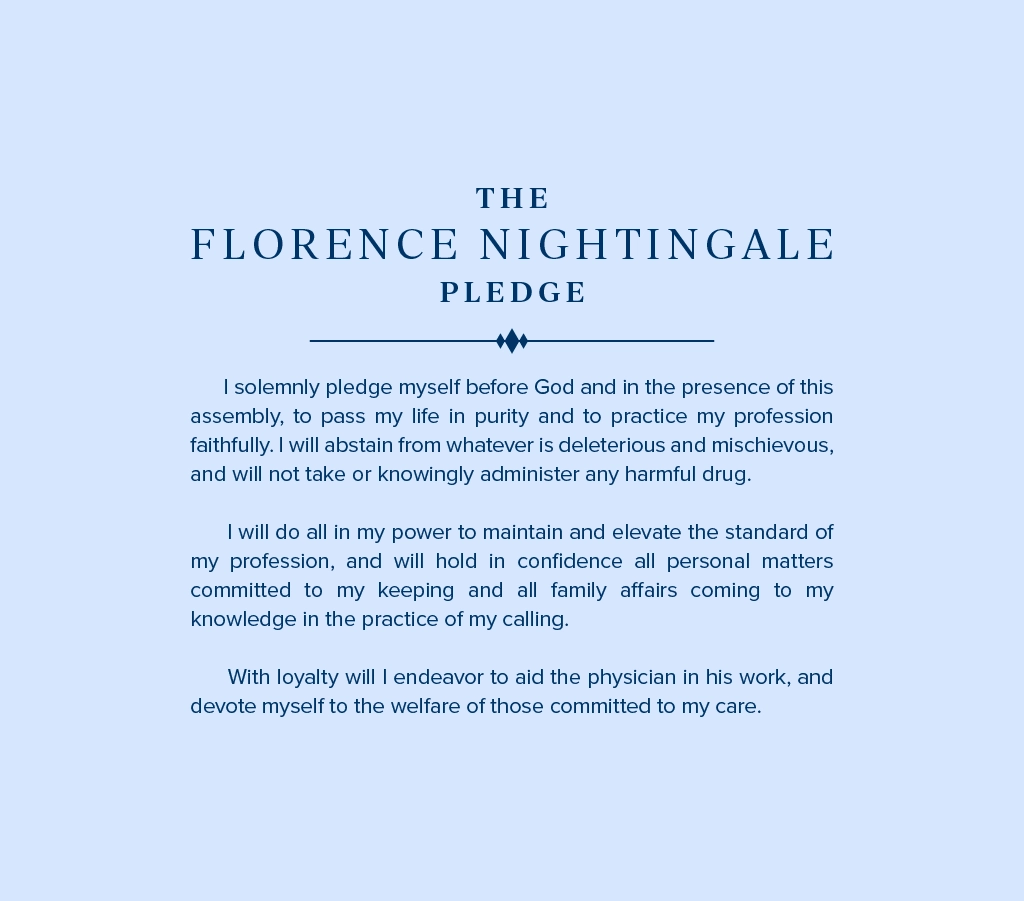
Reconciliation invites nursing to reinterpret Florence Nightingale’s pledge to serve ‘the welfare of those committed to my care’ through a contemporary lens that recognizes care as relational, land‑based, and accountable to Indigenous communities.
Nursing education finds its future in the hands of a generation willing to look back. In doing so, they carry nursing’s oldest ethic forward: care rooted in respect, humility, and shared humanity.